
TOL - 10th Aug, 2026
Oberg on Nick Scali's execution masterclass and why the shares could double
Strong margins, a profitable UK expansion and the prospect of significant store rollout have reinforced Oberg's conviction in Nick Scali.
 Add us as a preferred Google source
Retail has rarely been an easy place to invest, and with rate hikes and cost-of-living biting, it's unlikely to get any easier.
Consumers remain cautious, housing activity has softened, and furniture retailers continue to battle subdued demand across Australia. Yet Nick Scali (ASX: NCK) continues to execute, delivering resilient margins and, perhaps more importantly, demonstrating that its UK expansion is beginning to bear fruit.
For Wilson Asset Management Portfolio Manager Oscar Oberg, the latest results reinforce a long-held investment thesis. While the near-term backdrop is likely to remain challenging, he believes Nick Scali is the type of retailer that gains market share during tougher periods.
More importantly, he argues the UK business could eventually become comparable in size to the Australian operation, creating a much larger earnings base over time.
In the interview below, Oberg explains why he continues to rate NCK a Buy, the metric he believes investors should watch most closely, and why the current macro environment could ultimately create a better long-term buying opportunity.
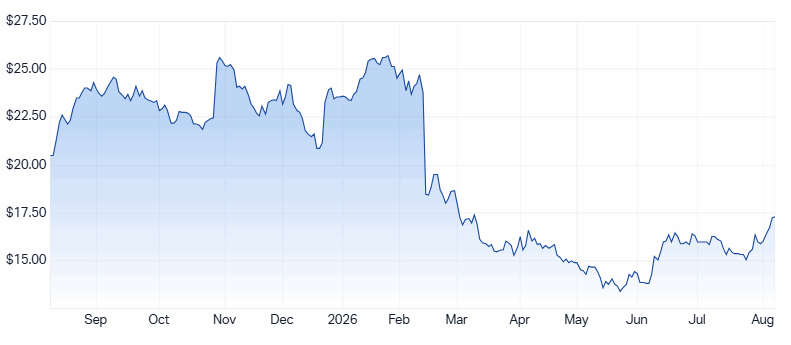
FY26 result
- Revenue up 4.3% to $516.7m vs $533.5m ests (3% miss)
- EBITDA up 13.6% to $180.7m vs $182.4m ests (1% miss)
- Group gross margin up 210bps to 65.6%
- NPAT up 22% to $75.7m vs $76m ests (in line)
- Final dividend up to $0.39 fully franked from $0.33 a year ago
Trading update (first five weeks of FY27)
Australia & New Zealand
- Written sales orders were flat year-on-year.
- Four new stores expected to open during FY27.
United Kingdom
- Written sales orders increased 35% year-on-year.
- One new store expected to open in October, with negotiations underway on several additional locations.

Do you currently hold Nick Scali and what do you rate it?
We hold Nick Scali in the portfolio, so obviously we like it. It's a Buy for us.
What mattered most from the result?
The standout for us was the gross margin, which remained exceptionally strong despite what has been a very difficult period, particularly in Australia during the second half.
The bigger takeaway, though, was the UK business. There have been plenty of question marks around whether that strategy would work, and this result showed it's now profitable while generating gross margins of more than 60%.
We've seen this playbook before with retailers like Lovisa. Once management proves it can successfully replicate the Australian model overseas, the market starts to price in that international growth opportunity.
We think that's exactly what's beginning to happen with Nick Scali. You're effectively buying the business during one of the weakest macro environments Australia has experienced, and we continue to like the stock.
How do those outcomes affect the outlook?
The near-term outlook remains tough in both Australia and the UK, and it could become even more challenging over the next six months.
That said, the best retailers consistently take market share during difficult trading conditions, and we think Nick Scali will do exactly that.
Looking further out, the opportunity looks very compelling.
If the UK business can continue producing metrics similar to the Australian operation, there is significant scope to roll out many more stores over time.
Five to seven years from now, the UK business could potentially be comparable in size to the Australian business.
That's why we own the stock. It's a high-quality company and, if that scenario plays out, we think the share price could potentially double from current levels.
What should investors be watching from here?
The biggest risk remains the macro environment, particularly if we were to see a significant correction in house prices.
However, because Nick Scali is a cyclical business, we'd actually view that as a buying opportunity. Strong operators tend to gain market share during downturns.
Markets also look 12 to 18 months ahead. If economic conditions deteriorate, there's every chance policymakers respond, and investors will begin pricing in the recovery before it appears in the numbers.
For me, the key metric remains the UK business. The improving margins, particularly exceeding 60% in the second half, were an extremely encouraging sign.
What could you be wrong about?
The biggest risk is simply that the macro environment deteriorates much more than expected.
Never miss an update
Enjoy this wire? Hit the ‘like’ button to let us know.
Stay up to date with my current content by
following me below and you’ll be notified every time I post a wire
Patrick is the Managing Editor (Editorial) at Livewire Markets, returning to the team after a four year hiatus. His focus is on editorial strategy, development, and of course, he still loves to write, host, and present when the opportunity arises.
Patrick was a Market Analyst, Editor, Senior Editor, and Managing Editor at Livewire Markets between 2015 and 2022. He was the Content Director and a member of the Investment Strategy & Research Group at Betashares between 2022 and 2024. He's also a Contributing Writer to Mining.com.au and Director of PLP Finance Media. He is an expert on listed products, commodities, and investment strategy, with a particular interest in gold and uranium.
........
Livewire gives readers access to information and educational content provided by financial services professionals and companies ("Livewire Contributors"). Livewire does not operate under an Australian financial services licence and relies on the exemption available under section 911A(2)(eb) of the Corporations Act 2001 (Cth) in respect of any advice given. Any advice on this site is general in nature and does not take into consideration your objectives, financial situation or needs. Before making a decision, please consider these and any relevant Product Disclosure Statement. Livewire has commercial relationships with some Livewire Contributors.

4 topics
1 stock mentioned
1 contributor mentioned

Patrick is the Managing Editor (Editorial) at Livewire Markets, returning to the team after a four year hiatus. His focus is on editorial strategy, development, and of course, he still loves to write, host, and present when the opportunity arises....
Expertise
Patrick is the Managing Editor (Editorial) at Livewire Markets, returning to the team after a four year hiatus. His focus is on editorial strategy, development, and of course, he still loves to write, host, and present when the opportunity arises....
Expertise
Comments
Comments
Sign In or Join Free to comment