TOL - 8th Jul, 2026
3 big shifts every investor should prepare for
US dominance isn't over but investors should begin preparing for a much broader opportunity set.
 Add us as a preferred Google source
For much of the past two decades, global investing has been a relatively straightforward exercise. US equities delivered superior earnings growth, valuations continued to expand, and a strengthening US dollar amplified returns for international investors.
I don’t believe that story is over, but I do expect the next chapter to look different.
As we reach the midpoint of 2026, the global investment landscape is changing in ways that investors cannot afford to ignore. While geopolitical events continue to dominate the headlines, the more important shifts are structural. In my view, three themes will define markets over the years ahead: the US dollar is likely to weaken, developed-market yield curves are likely to steepen, and non-US equity markets are increasingly well positioned to outperform on a relative basis.
These are not isolated forecasts. Together, they point to a world where investors may once again be rewarded for diversifying beyond the United States.
The content below shares some of the highlights of Lazard's Global Outlook 2026. The full document is available for download at the bottom of the wire.
Three structural shifts are reshaping markets
The first of my convictions is that the US dollar is likely to weaken over time.
After surging through 2021 and 2022, the dollar has already surrendered much of those gains. I believe that trend has further to run as global investors reassess their exposure to US assets amid rising policy uncertainty, elevated fiscal deficits and concerns about long-term debt sustainability.
Today’s global equity market is extraordinarily concentrated. US equities now account for more than 60% of the MSCI All Country World Index, while US government debt represents more than 40% of the Bloomberg Global Aggregate Bond Index. Many institutional investors are becoming increasingly uncomfortable with that concentration, even if they remain reluctant to reduce exposure while AI continues to support US markets.
Over time, I believe that reassessment will lead to greater diversification away from US assets.

My second conviction is that developed-market yield curves are likely to steepen.
Governments across the developed world are borrowing heavily. In the United States, I expect federal deficits to remain between 6% and 8% of GDP for much of the next decade. Europe is increasing defence and infrastructure spending, while Japan is pursuing more expansionary fiscal policies.
Eventually, investors will demand higher compensation for funding those deficits.
That creates a more challenging backdrop for long-duration government bonds and raises the hurdle for highly valued growth assets whose valuations depend on low discount rates.
My third conviction follows naturally from the first two.
After almost two decades of American exceptionalism, I believe the relative performance gap between the United States and international markets is narrowing. Currency movements, lower starting valuations and improving earnings prospects all point towards stronger relative returns outside the United States.
This is not a call to abandon US equities, rather, it is a call to broaden the opportunity set.
AI remains one of the biggest opportunities but expectations have become demanding
Artificial intelligence continues to reshape the global economy and remains one of the most important investment themes of our time.
However, I believe investors are becoming increasingly optimistic about the returns that will ultimately be generated from the enormous amount of capital currently being deployed.
US hyperscalers are expected to spend more than US$750 billion on AI infrastructure this year alone, with cumulative investment potentially reaching between US$5 trillion and US$10 trillion by the end of the decade.
The question is no longer whether AI will transform the economy; it will. The more important question is whether shareholders will earn attractive returns on that investment.
Some AI-related companies have seen their share prices rise by more than 1,000% since early 2025. Those valuations require years of exceptional revenue growth, sustained high margins and limited competitive pressure.
History suggests that technology rarely evolves in such a straight line. This is not to say there will be no winners. Hardware suppliers across the United States and Asia continue to benefit enormously from the AI arms race. My concern is simply that investors are increasingly paying for perfection.
As AI becomes more widely adopted, I suspect cost and reliability will become more important than always having the most advanced model. Fast followers investing far less capital may ultimately prove formidable competitors. Selectivity will become increasingly important.
The opportunity set is broadening beyond America
Despite my more constructive view on international markets, I remain positive on the long-term outlook for many US companies.
American businesses continue to generate superior returns on capital compared with most global peers, and those higher-quality businesses deserve to trade at premium valuations.
The challenge is that much of this superiority is already reflected in share prices.
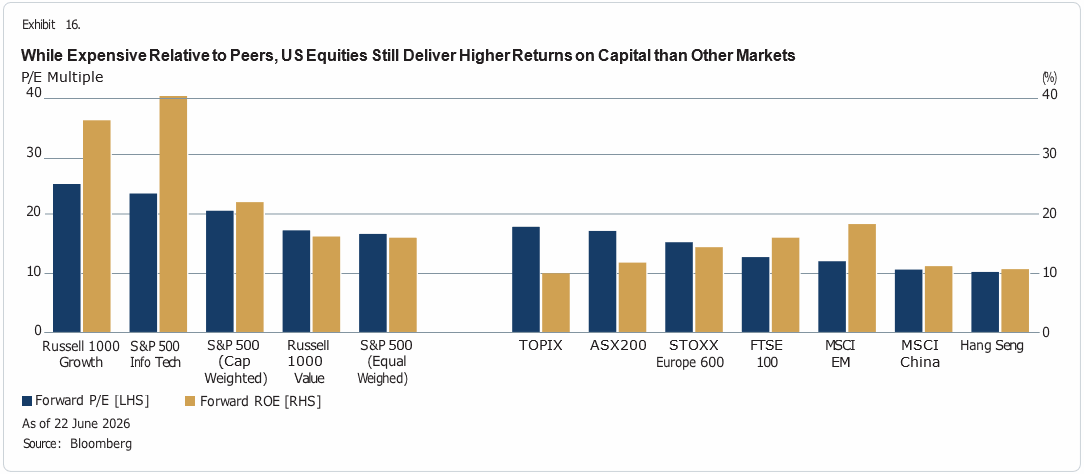
Elsewhere, I believe investors are being paid more generously for accepting risk.
Japan remains one of the most attractive developed markets. Corporate governance reforms continue to improve returns on capital, shareholder outcomes are becoming increasingly important, and policy settings remain supportive of domestic consumption. A stronger yen could also provide an additional tailwind for international investors.
Emerging markets also deserve greater attention. Valuations remain considerably lower than those in the United States, while many companies offer exposure to long-term growth themes—including artificial intelligence—without requiring investors to pay Silicon Valley valuations.
Europe’s outlook is more mixed. Higher energy prices and geopolitical uncertainty continue to weigh on economic activity, but rising defence spending could become one of the region’s most important structural growth drivers over the coming decade, supporting industrial production, infrastructure investment and technological innovation.
I remain more cautious on China. While headline economic growth has remained resilient, ongoing weakness in the property market, subdued consumer confidence and an increasing reliance on exports suggest the country’s underlying economy is more fragile than headline GDP figures imply.
Building portfolios for a different decade
If my outlook proves broadly correct, investors may need to rethink some of the assumptions that have served them well for much of the past twenty years.
Concentrated exposure to US equities has been an exceptionally successful strategy, but I believe the coming decade is likely to reward broader diversification.
That doesn’t mean turning away from the United States. It means recognising that attractive opportunities are becoming more widely distributed across global markets.
I also believe investors should pay closer attention to real assets, particularly infrastructure businesses with contractual pricing power that can provide protection against structurally higher inflation. At the same time, I remain cautious on long-duration government bonds, where persistent fiscal deficits may continue to place upward pressure on yields.
Markets are entering a new phase
The forces that shaped the investment landscape after the Global Financial Crisis are evolving, and with them, the opportunities available to investors.
In my view, portfolios built for the next decade should reflect that reality by looking beyond traditional market leadership and embracing a broader set of opportunities across regions, sectors and asset classes.
Never miss an update
Enjoy this wire? Hit the ‘like’ button to let us know.
Stay up to date with my current content by
following me below and you’ll be notified every time I post a wire
Ronald Temple is the Chief Market Strategist for Lazard’s Financial Advisory and Asset Management businesses. In this role, Ron provides macroeconomic and market perspectives to Lazard’s investment teams on a firmwide basis and works closely with Lazard’s Geopolitical Advisory group to assess economic and market implications of key geopolitical issues globally. Ron also advises clients of Lazard’s Asset Management businesses regarding macroeconomic and market considerations that are important to achieving their objectives. Previously, Ron was the Head of US Equity and Co-Head of Multi-Asset Investing for Lazard Asset Management. In this role, Ron was responsible for overseeing the firm's US equity strategies, Multi-Asset investing, as well as several global equity strategies. He was also a Portfolio Manager/Analyst on various US and global equity teams.
........
Livewire gives readers access to information and educational content provided by financial services professionals and companies ("Livewire Contributors"). Livewire does not operate under an Australian financial services licence and relies on the exemption available under section 911A(2)(eb) of the Corporations Act 2001 (Cth) in respect of any advice given. Any advice on this site is general in nature and does not take into consideration your objectives, financial situation or needs. Before making a decision, please consider these and any relevant Product Disclosure Statement. Livewire has commercial relationships with some Livewire Contributors.
.png)
4 topics
.png)
Ronald Temple is the Chief Market Strategist for Lazard’s Financial Advisory and Asset Management businesses. In this role, Ron provides macroeconomic and market perspectives to Lazard’s investment teams on a firmwide basis and works closely with...
Expertise
Ronald Temple is the Chief Market Strategist for Lazard’s Financial Advisory and Asset Management businesses. In this role, Ron provides macroeconomic and market perspectives to Lazard’s investment teams on a firmwide basis and works closely with...
Expertise
Comments
Comments
Sign In or Join Free to comment