TOL - 20th Jul, 2026
Acorn's Rick Squire says the resources rally is changing shape. Here's 3 ASX stocks he likes
Rick Squire explains why the resources rally isn't over, why copper and uranium still appeal, and three stocks he likes today.
 Add us as a preferred Google source
You might have heard talk recently, even on Livewire, about a potential commodities supercycle. The general thrust is that AI has turbocharged demand for numerous commodities, following a period of lower capex and resource development.
It's a classic case of demand exploding against a limited supply. Even if the thesis proves correct, however, commodity cycles rarely move in straight lines.
Just when investors think they've identified the next winning theme, geopolitics intervenes, inflation changes direction, or capital begins flowing into a different part of the market altogether. The challenge, therefore, isn't simply identifying the right commodity. It's identifying where the market will reward investors.
Few people are better placed to answer that question than Acorn Capital's Rick Squire.
"It's important to remember that with the resources and energy sectors, there's actually a number of commodities that make up that part of the sector. And so you shouldn't just lump it all into one bucket and say, 'yes, they'll all behave similarly', because they certainly don't."
That's the lens through which Squire approaches investing. Rather than treating resources as one homogeneous sector, he analyses each commodity independently before drilling down into the producers, developers and explorers best positioned to benefit.
In this interview, Squire explains why he's constructive on copper and uranium, why he's thinking differently about gold than he was at the start of the year, how he assesses mining projects through a geologist's lens, and the three stocks he believes deserve investors' attention.

INTERVIEW SUMMARY
Copper and uranium remain the standouts
Despite strong performances across parts of the resources sector, Squire believes copper and uranium continue to offer compelling opportunities.
The uranium story remains underpinned by structural demand, as countries look to expand nuclear power to meet growing electricity demand, particularly driven by artificial intelligence. While uranium equities have cooled after an earlier rally, Squire believes the long lead times required to build new reactors and develop new mines continue to support the long-term investment case.
Copper, meanwhile, is being driven by more than just AI. While additional electricity infrastructure remains an important driver of demand, Squire believes the bigger story today is constrained supply.
"What I've been more focused on is actually the supply constraints... that there's been some disruptions to supply. It's been difficult to start up and ramp up the existing operations.
So that's created some price pressure around the copper price. And so in the near term and medium term, I'm really positive on copper as well."
Gold has moved to a different phase
Although Squire remains constructive on gold, he says the investment opportunity has changed significantly over the past six months.
Earlier in the year, he expected capital to continue moving down the value chain from producers to developers and explorers. Instead, renewed conflict in the Middle East and rising inflation expectations have interrupted that progression.
Rather than abandoning gold altogether, Squire has simply adjusted where he wants exposure.
"I'm still positive on gold, but what it means is the cycle has moved probably back towards those producers and away from the explorers and the early stage developers in that cycle."
The same framework applies across commodities. For copper and uranium, he believes investors are now approaching the stage where explorers and developers can begin to outperform as capital searches for the next generation of discoveries.
What separates a good project from a bad investment?
Squire's background as a geologist heavily influences how he assesses opportunities.
For explorers, he starts with the commodity, then narrows his focus to projects capable of delivering genuinely meaningful discoveries. Scale is critical, but so too is practicality.
Projects that require billions of dollars to develop often carry financing risks that smaller companies struggle to overcome, while marginal deposits can quickly become uneconomic if commodity prices weaken.
Developers are judged through a similarly pragmatic lens. Squire favours companies that can shorten the path to production, whether through existing processing infrastructure, care-and-maintenance assets or toll-treatment opportunities. Short development timelines and manageable capital requirements reduce execution risk and improve the likelihood of shareholder returns.
Beyond the geology, management quality remains a decisive factor. He believes many technically capable teams underestimate the importance of capital markets expertise, particularly their ability to raise funds without unnecessarily diluting existing shareholders.
Environmental, social and governance considerations also remain firmly on his checklist. While ESG may no longer dominate headlines, Squire says understanding jurisdictional risk and maintaining a social licence to operate remain fundamental to long-term investment success.
Three stocks on his radar
Asked to give the bull case on a couple of stocks he likes right now, Squire highlighted three businesses at different stages of development.
#1 - Solstice Minerals (ASX: SLS)
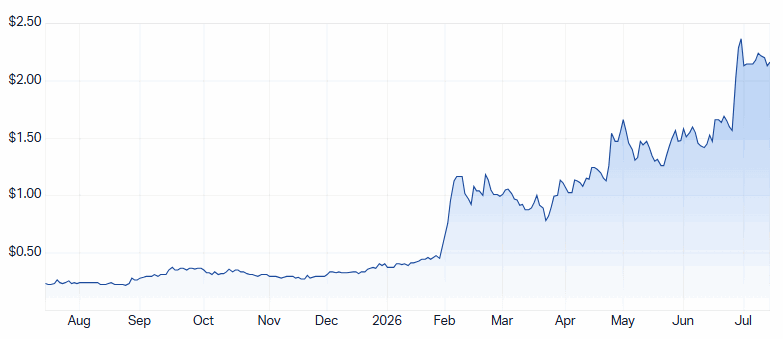
Squire believes the company's Western Australian copper discovery combines the two characteristics he values most: genuine scale and a location already covered by a mining lease, which could allow future development to progress more quickly through the permitting process.
# 2 - Midas Minerals (ASX: MM1)
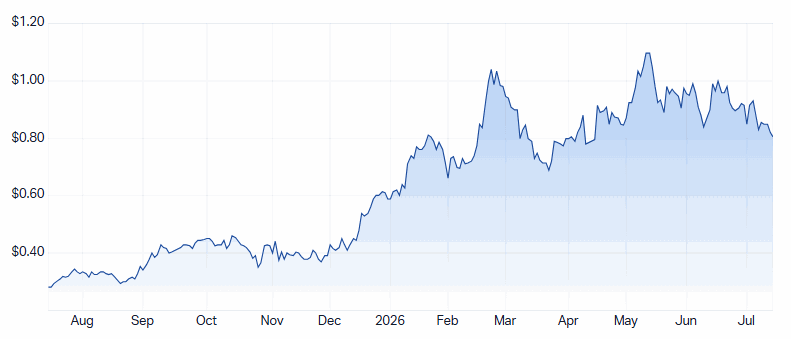
Midas is advancing a copper-silver discovery in Namibia. Having visited the project earlier this year, Squire says the quality of the drill results, combined with Namibia's attractive mining jurisdiction, make it one of the more exciting emerging copper stories.
#3 - Meteoric Resources (ASX: MEI)
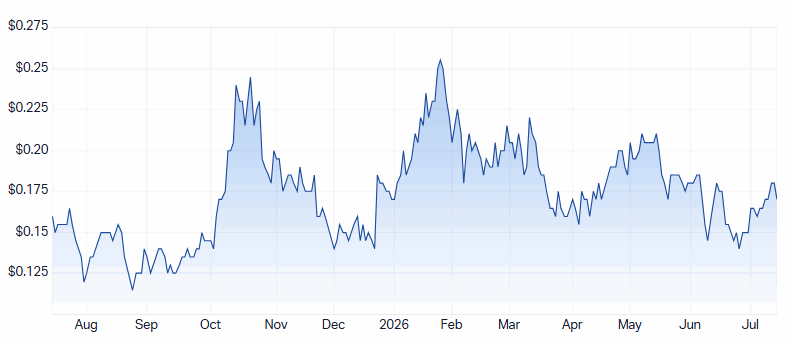
The Brazilian rare-earth developer has been a long-time favourite, but Squire believes that improving recognition of the strategic importance of heavy rare earths is creating a more supportive backdrop. With what he considers a world-class asset, the right mix of rare-earth elements and steady progress through permitting, he sees the company approaching an important inflection point.
Watching for the next wave
The biggest wildcard for resource investors, according to Squire, remains geopolitics.
An enduring peace in the Middle East could materially reshape inflation expectations, interest rate forecasts and capital flows across commodity markets.
Equally, an extended period of disruption could continue supporting energy prices while delaying a broader rotation within precious metals.
Either way, Squire believes investors shouldn't think about the resources sector as a single trade. Instead, understanding where each commodity sits in its own investment cycle, and where capital is likely to flow next, remains the key to uncovering tomorrow's winners.
Never miss an update
Enjoy this wire? Hit the ‘like’ button to let us know.
Stay up to date with my current content by
following me below and you’ll be notified every time I post a wire
My passion is equity research, portfolio construction, and investment education. There are some powerful processes that can help all investors identify great opportunities and outperform the market, and I want to bring them to life and share them with you.
........
Livewire gives readers access to information and educational content provided by financial services professionals and companies ("Livewire Contributors"). Livewire does not operate under an Australian financial services licence and relies on the exemption available under section 911A(2)(eb) of the Corporations Act 2001 (Cth) in respect of any advice given. Any advice on this site is general in nature and does not take into consideration your objectives, financial situation or needs. Before making a decision, please consider these and any relevant Product Disclosure Statement. Livewire has commercial relationships with some Livewire Contributors.

5 topics
3 stocks mentioned
1 contributor mentioned

My passion is equity research, portfolio construction, and investment education. There are some powerful processes that can help all investors identify great opportunities and outperform the market, and I want to bring them to life and share them...
Expertise
My passion is equity research, portfolio construction, and investment education. There are some powerful processes that can help all investors identify great opportunities and outperform the market, and I want to bring them to life and share them...
Expertise
Comments
Comments
Sign In or Join Free to comment