AI has levelled up again: Here's what you need to know
Models have become a lot smarter, but how developers are using them is quickly making and breaking businesses.
 Add us as a preferred Google source
We talk about AI a lot here at Minotaur Capital. If you read the full spectrum of the financial press, you're probably sick of us by now. But the pace of acceleration in the final weeks of 2025 surprised even us – enough that we think it's worthwhile dedicating a good chunk of commentary to what's changed, what we've built, and what it means for software stocks.
Two shifts have converged in the last few months to create what feels like a step-change in AI capability. Neither is purely about the models getting smarter (though they have). Both are about how we use them.
Shift One: Skills Expand What AI Can Touch
The first shift is skills. A large language model can only take so much text (known as the context window), and the more you give it, the worse it tends to perform. If you want it to know how to do a hundred different things, you could give it all those instructions upfront, but that degrades performance. Skills solve this by giving the model a short description of what it could learn upfront, and if it needs that capability, it asks for the full instructions. It keeps the model focused and working better.
When Anthropic launched their Skills system in October, they provided a standardised format for packaging and sharing these instructions. The Skills Marketplace, a collection of skills aggregated from open sources (not vetted, so read any before you use them), now has over 77,000 skills. Your agent doesn't know how to work with Excel? Give it a skill, and it now does.
We've built our own library of skills that give our agents access to external services and take actions on our behalf. A lot more tasks are now automatable, and because skills are shareable, the ecosystem compounds.
Shift Two: From Chatting to Loops
The second shift matters more. We're moving from chatting with AI to running AI in loops.
Geoffrey Huntley, previously Canva's AI Developer Productivity Tech Lead, popularised a deliberately unsophisticated approach under the name "Ralph Wiggum", where he defines what "done" looks like in a specification file, runs the agent in a loop, gives each iteration a fresh context window, but lets it see what was built before. As Huntley put it when explaining the name: "It's kind of dumb, kind of lovable, and it never gives up." The contrast with complex multi-agent orchestration systems is striking: the dumb approach, through sheer iteration, often outperforms the clever one.
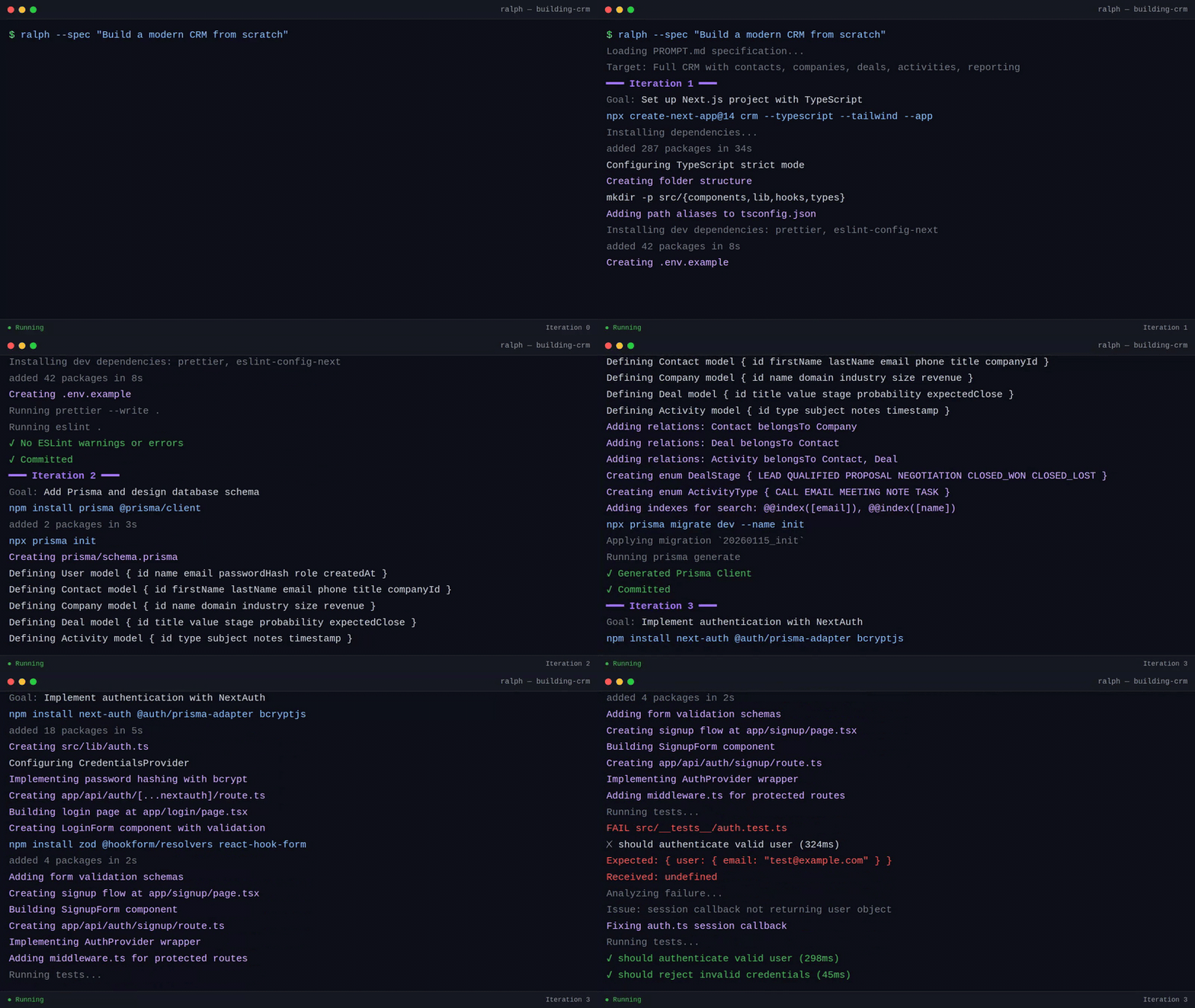
The Ralph Wiggum technique: run AI in a loop until the task is complete. This one is building a CRM (customer relationship management) system. Accelerated for dramatic effect.
Huntley first presented it at a San Francisco meetup in June 2025, published the approach in July, and by December, it had gone viral. Anthropic released an official Claude Code plugin for it. VentureBeat ran a feature story.

Geoffrey Huntley on his unconventional approach to AI development.
What made loops suddenly viable? As Huntley put it: "Over the last year, the models have become quite good, and it's only now that I'm able to realise this full vision." Claude Opus 4.5 arrived in late November; GPT-5.2 and GPT-5.2-Codex followed in December. Better harnesses helped, too. A harness is the layer between you and the model. It's what lets the AI read files, run commands, and take actions rather than just chat. Tools like Claude Code, Cursor, and OpenCode handle context management, permissions, and multi-session workflows, making the models far more capable.
What We Built at Minotaur Capital
Over the Christmas break, I built a personal AI assistant (and a Minotaur Assistant for the team) with skills for email, calendar, Slack, Xero, Confluence, web search, image generation, and our internal fund reporting. I also built automation scripts that run AI agents in loops against task lists, converting unstructured notes into structured plans and executing them overnight while I slept.
Now we can give the assistant tasks like "read this email from our lawyers and update our notes on ETF setup costs" or "why is Lenovo down?" (which triggers a skill that simultaneously searches news, X, and email before responding). It can read an investor's due diligence request, pull the relevant fund data, and generate a customised Excel report tailored to the specific request – a task that could previously take hours of manual work. Each new skill expands what's automatable without polluting unrelated tasks with irrelevant context.
What This Means for Software Stocks
This brings us to a debate we've been having internally. We suspect many investors are having it too.
A few days after my holiday coding sprint, Arms and my exchange went something like:
Thomas: "I'm not sure about software after my week of coding..."
Arms: "I think Atlassian will be fine."
Thomas: "There's been a step change... my week just made it visceral."
That word visceral matters. These improvements don't arrive as neat, linear progress you can tidy up in a spreadsheet. They arrive as sudden "oh wow" moments that change what feels possible.
Software stocks have been hammered. HubSpot (NYSE: HUBS) is down over 55% from its January 2025 levels. Atlassian (NYSE: TEAM) has more than halved. Adobe (NYSE: ADBE) and Salesforce (NYSE: CRM) are both down around 30%. Oppenheimer downgraded Adobe in mid-January, stating software has "flipped from an AI beneficiary to an AI victim."

"I'm in danger." – Ralph Wiggum
Part of it is sentiment catching up to what developers have been experiencing. If AI can compress the time and cost to build software by an order of magnitude, what happens to the companies that sell it?
There's an economic shift at the heart of this. A year ago, AI wasn't good enough to substitute for software development; you had to use developers. Now the output quality has crossed a threshold where it's genuinely useful, and it's cheap. If capable LLMs were free and infinitely fast, you'd always prefer brute force iteration over careful human design. We're moving in that direction. The dumb loop that runs overnight starts to look more attractive than the carefully reviewed pull request.
What does this mean for software stocks? We think about the risks through three lenses:
1. Build vs Buy: Can organisations code their own solutions instead of buying software? For some tools, yes. But there are reasons most won't: maintenance burden, liability, and what happens when things break at 2 am, for starters. That said, complex enterprise software where you only use 10% of the features? Sometimes, a custom tool that does exactly what you need, integrated exactly how you want, is genuinely better. It's one reason we write a lot of software ourselves.
2. Competitive Intensity: If the cost and time to build software fall materially, what happens to competitive dynamics? New companies can spin up faster. Existing competitors can ship products faster. The cost to build "good enough" alternatives falls. This doesn't mean incumbents lose, but it lowers the barrier to entry, which changes who can afford to compete.
3. Per-Seat Pricing: Because AI can do more jobs, particularly entry-level tasks, we wouldn't be surprised if teams simultaneously produce more while being smaller. Services that charge per seat face pressure. Transitioning to different pricing models (outcomes-based, consumption-based) isn't trivial.
None of this means "software is dead." The simplistic "AI kills software" narrative is too linear. But the risk environment has changed, and it makes sense that these stocks are re-rating.
Even sceptics are shifting. David Heinemeier Hansson, creator of Ruby on Rails and a vocal sceptic of AI hype, recently admitted that half his resistance was "simply that the models weren't good enough yet." That's no longer the case.

Even AI sceptics are updating their views.
The Orchestration Layer
One dynamic that interests us is where value accrues in this new stack.
If an AI assistant becomes the layer that sits between you and your services – email, calendar, documents, CRM, research, analytics – then the underlying UI becomes less important. The "winner" is whoever owns the permissions, the workflow graph, the audit trail, and the ability to safely take action across systems.
That has second-order implications. Some software becomes more defensible (if it is the control plane). Some become less defensible (if it's a thin UI over commoditised functionality). Value may shift toward platforms that can govern agentic workflows rather than those that just serve screens. We're already living this. We don't pay for software unless we can access it via an API. If it can't fit into our automated systems, we don't use it.
On January 12, Anthropic launched Claude Cowork, a desktop agent that manages files, connects to services like Notion and Asana, and executes multi-step tasks autonomously. It's essentially a consumer-friendly version of what we built ourselves over Christmas, though less powerful. Microsoft is integrating Claude into Copilot. OpenAI is pushing ChatGPT as the default interface. The race to own the orchestration layer is already underway.
Portfolio Implications
In terms of what this means for our portfolio, we've reduced our software exposure since quarter-end, including cutting Atlassian, despite our bullish commentary on the name and sector late last year. We sold because the goalposts are shifting fast on unit economics and defensibility of seat-based workflow software as agentic tooling spreads. The distribution of outcomes has widened materially, and at current prices, we don't think the risk-reward is attractive.
We still believe in the AI supercycle. Our positions in Nvidia (NYSE: NVDA) and the memory makers (discussed in our December monthly) reflect this. Compute and infrastructure demand remain strong.
We also initiated a position in Hut 8 (NYSE: HUT) during the quarter. On December 17, Hut 8 announced a 15-year, 245 MW data centre lease to Anthropic at their River Bend campus in Louisiana, backstopped by Google (AA+ credit), with a total contract value of US$7 billion. We bought the stock that day. We were able to move quickly both because of AI-assisted analysis and because the deal structure was familiar. In a prior role, Thomas was a large shareholder in NEXTDC and Asia Pacific Data Centre, the trust NEXTDC created to fund their land and buildings when capital was scarce. River Bend has a similar feel – contracted, investment-grade-backed infrastructure with visible cash flows. On mid-point build cost estimates and before capitalised interest, the project yields ~15% unlevered in year one, rising with 3% annual escalators over the lease term. We thought the market was underpricing the impact of this deal on the company.
Staying Right as Facts Evolve
In a world that compounds change, good investing isn't about being right once. It's about staying right as the facts evolve.
AI moves in dog years. The past twelve months feel like seven years of progress. OpenAI's Deep Research isn't even a year old. Skills launched three months ago. Opus 4.5 arrived two months ago. The Ralph Wiggum pattern went viral this month. Each felt like a step change at the time. They're stacking up. The big unknown for software stocks isn't where we are now. It's where we'll be in another twelve months if this pace continues.
We see this in our own work. Since starting Minotaur, AI has become increasingly central to our research process. With this latest wave, it's now thoroughly entrenched. We're building AI systems that are deliberately "opinionated", in that they encode our philosophy, our decision rules, our view of what matters. The problem with using off-the-shelf ChatGPT to research or summarise is that by the time you're looking at the output, you're trying to extract insight from something that's already been compressed. Information has been lost. The signal you needed might have been discarded as noise. Because we've infused our AI with how we actually think, we can apply that lens at the detail level, before the loss compression, not after.
The progress we've made in incorporating AI into the deeper parts of our research process makes us think it won't be long before we can generate full investment recommendations with AI. At that point, we'll be able to measure whether the human judgement of Thomas and Arms adds or detracts value beyond the systems we build.
Diogenes once said to a would-be philosopher about the importance of lived experience vs. textbook: "You do not choose painted figs, but real ones… and yet you pass over the true training and would apply yourself to written rules." In markets right now, there's no shortage of "painted figs", i.e., investors opining loudly on AI's impact on software without actually using the tools. Our advantage is simple: we eat the real figs. We build with these systems, run them in loops, and rely on them both in research and operationally. That's why we're not guessing when a step-change matters – we actually feel it, which is why we can change our mind with discipline when the facts move.
Never miss an update
Enjoy this wire? Hit the ‘like’ button to let us know.
Stay up to date with my current content by
following me below and you’ll be notified every time I post a wire
Thomas co-founded Minotaur Capital in November 2023. Minotaur is a fundamental global equities firm that utilises technology and software to enhance the investment process.
Prior to this, Thomas spent 9 years at Perpetual from June 2014 to October 2023. In June 2017, he setup and ran the Perpetual Global Innovation Share Fund, which was the highest-performing equities fund in Australia in FY23.
Before Perpetual, Thomas spent 11 1/2 years at PM Capital, first as a global equities analyst covering multiple sectors, and later as the Portfolio Manager of the PM Capital Australian Opportunities Fund.
........
Livewire gives readers access to information and educational content provided by financial services professionals and companies (“Livewire Contributors”). Livewire does not operate under an Australian financial services licence and relies on the exemption available under section 911A(2)(eb) of the Corporations Act 2001 (Cth) in respect of any advice given. Any advice on this site is general in nature and does not take into consideration your objectives, financial situation or needs. Before making a decision please consider these and any relevant Product Disclosure Statement. Livewire has commercial relationships with some Livewire Contributors.

4 topics
6 stocks mentioned
1 contributor mentioned

Thomas co-founded Minotaur Capital in November 2023. Minotaur is a fundamental global equities firm that utilises technology and software to enhance the investment process. Prior to this, Thomas spent 9 years at Perpetual from June 2014 to...
Expertise
Thomas co-founded Minotaur Capital in November 2023. Minotaur is a fundamental global equities firm that utilises technology and software to enhance the investment process. Prior to this, Thomas spent 9 years at Perpetual from June 2014 to...
Expertise
Comments
Comments
Sign In or Join Free to comment