TOL - 10th Jul, 2026
ASX insiders maintain buying rage in June quarter - who's been making moves?
Want to know who is buying and selling their own stock? Join Livewire's Chris Conway for the quarterly insider moves update.
 Add us as a preferred Google source
The June quarter marked a decisive shift in sentiment among ASX directors, with insider buying comfortably outpacing selling as executives and board members backed their own companies.
There were a total of 33 sets (a set = three directors or more) of transactions involving net insider buying during the quarter, compared with just seven sets of transactions involving net insider selling, making it one of the strongest buying imbalances in recent reporting periods.
While directors continued to favour companies whose share prices had fallen sharply, they also showed an increased willingness to buy into businesses already enjoying positive momentum.
Meanwhile, selling activity remained concentrated among companies that had delivered strong returns, suggesting many insiders were simply taking profits rather than signalling deteriorating prospects.
As always, insider trading isn't a crystal ball. Directors buy and sell shares for many reasons, and no investment decision should ever be based solely on insider activity. But when those closest to a business commit meaningful amounts of their own capital, it can provide a valuable insight into how they view the company's prospects.
Below, we examine where insiders have been buying and selling during the June quarter.
Refresher on the research
For those new to the series, here is some important background information.
When multiple insiders buy or sell, it can tell an interesting story. Don't forget that these insiders are all sitting around the same boardroom table and responding to the same stimulus.
As explained in the first wire that introduced this series, research shows that the percentage of insider trades decreases as the share price moves from 52-week lows towards 52-week highs. Put simply, insiders buy more when their stocks are 'cheap' and buy less when they are 'expensive'.
Even with many ASX companies (north of 80% for the ASX 100) having policies that require board members to hold stock in a company, they typically have long periods (up to 5 years) to acquire the stock to meet the requirements, so they still have the ability to attempt buying when the stock is 'cheap'.
This is why it is interesting to examine share price movements over 3-month and 1-year periods alongside transaction sets to establish the conditions under which insiders are making moves. All the data we have examined, including that in this update, aligns with the long-term research.
Please note that these are simply observations based on the data. We cannot possibly know the true motives behind any director's buying or selling of stock in their own company (unless they disclose them to the market). The data includes on-market transactions. It does not include rights issues, participation in off-market share purchase plans, options exercised, or dividend reinvestment plans.
The latest numbers - Transactions that involved NET BUYING
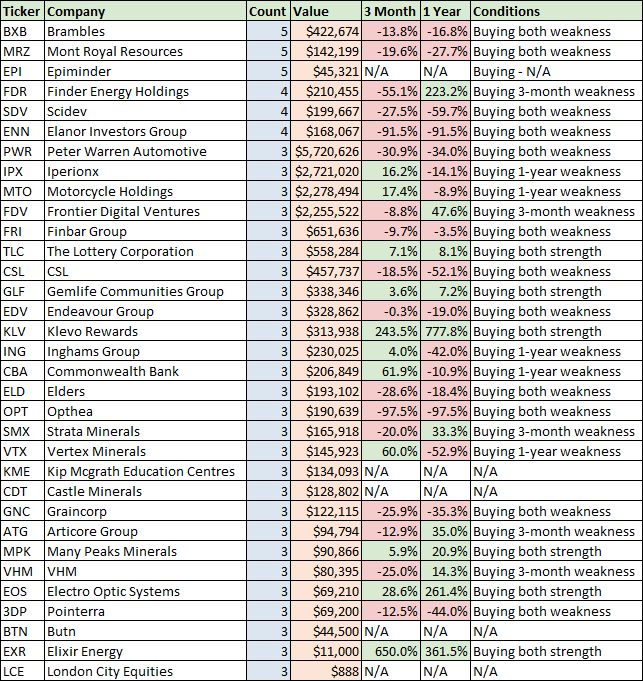
- Of the 33 companies that recorded net insider buying, 12 saw directors buying after both three-month and one-year share price declines. Companies such as Brambles, Peter Warren Automotive, CSL, GrainCorp, Endeavour Group and Elders all fall into this category, suggesting insiders believe recent weakness has created attractive entry points.
- Another five companies were bought following short-term weakness despite remaining higher over the past year. These "dip buyers" include Finder Energy Holdings, Frontier Digital Ventures, Articore Group and VHM, with directors stepping in after recent pullbacks.
Interestingly, insider confidence wasn't limited to beaten-down stocks.
- Directors bought six companies that had risen over both the past three months and the past year, including The Lottery Corporation, GemLife Communities, Electro Optic Systems and Elixir Energy. These purchases suggest some insiders remain confident that recent momentum can continue.
- Finally, five companies fell into the "recovery" category, with directors buying despite positive three-month performance while shares remained down over the past year. These included IperionX, Motorcycle Holdings, Commonwealth Bank, Inghams Group and Vertex Minerals.
In terms of breadth of conviction, Brambles, Mont Royal Resources and Epiminder recorded the highest number of buying insiders, with five directors buying in each case, while the largest dollar purchases came from Peter Warren Automotive ($5.7 million), IperionX ($2.7 million), Motorcycle Holdings ($2.3 million) and Frontier Digital Ventures ($2.3 million).
The latest numbers - Transactions that involved NET SELLING
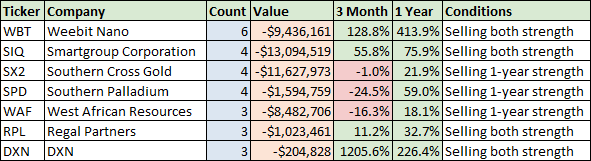
Selling activity painted a very different picture. Rather than directors exiting struggling companies, the overwhelming majority of selling occurred after strong share price gains.
- Four companies — Weebit Nano, Smartgroup, Regal Partners and DXN — saw directors selling into both three-month and one-year strength. Weebit Nano's shares, for example, had rallied more than 400% over the previous year, DXN's were up more than 200%, while Smartgroup had gained almost 76%.
- The remaining three companies — Southern Cross Gold, Southern Palladium and West African Resources — all recorded selling after positive one-year performance despite weaker recent trading.
Notably, there were no examples of directors selling companies that had fallen over both the past three months and one year. That absence is almost as telling as the buying itself. If directors genuinely believed conditions were deteriorating, history suggests we'd expect to see at least some selling among the market's weakest performers.
Instead, the June quarter was characterised by insiders adding to companies they viewed as undervalued while trimming holdings in stocks that had already enjoyed substantial gains.
What does it mean?
Insider activity should never be viewed in isolation, but this quarter's data sends a fairly consistent message.
Directors appear considerably more willing to deploy capital than they are to cash out. More importantly, most buying remains concentrated in companies that have underperformed, suggesting those closest to the businesses believe the market has become overly pessimistic in a number of cases.
At the same time, the relatively small amount of selling appears driven primarily by profit-taking after strong rallies rather than concerns about future prospects.
Taken together, the June quarter represents one of the more constructive insider signals we've seen in recent quarters.
INTERESTING OBSERVATIONS
Brambles (ASX: BXB): Broad-based buying from the board
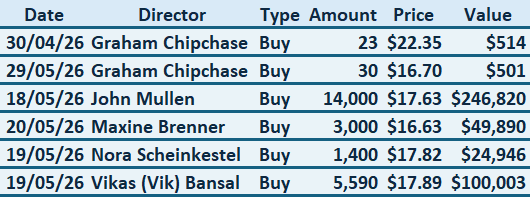
Brambles topped the June quarter rankings for coordinated insider buying, with five separate directors purchasing shares following a difficult period for the stock, which was down almost 14% over three months and 17% over the past year.
Unlike many companies where buying is driven by a single director, Brambles saw purchases from Chairman John Mullen, Maxine Brenner, Nora Scheinkestel, Vik Bansal and CEO Graham Chipchase. Collectively, they invested more than $420,000 of their own money.
When multiple independent directors all decide the shares represent value at roughly the same time, it is generally viewed as one of the stronger insider signals.

Fundie view
On a recent episode of Buy Hold Sell, Yarra's Marcus Ryan was less convinced than the recent buyers, nominating BXB as a stock to avoid over the coming 12 months. He said the following;
We remain cautious on Brambles. The stock has already fallen around 25% from its highs after the company disclosed disruptions within its US pallet repair subcontractor network. Some subcontractors were unable to repair pallets and return them to the network efficiently. We think there are still risks the market may not have fully accounted for.
The reader poll attached to that episode saw 47% of 757 voters rate BXB a HOLD, whilst 37% said SELL, and 17% said BUY.
Peter Warren Automotive (ASX: PWR): A $5.7 million vote of confidence
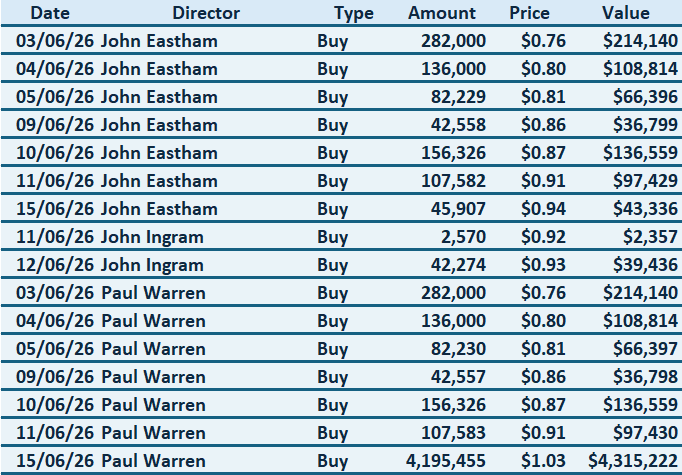
Peter Warren Automotive recorded by far the largest insider buying commitment of the quarter, with directors investing more than $5.7 million after the shares fell around 31% over three months and 34% over the past year.
The buying was dominated by founders John Eastham and Paul Warren, who steadily accumulated shares across multiple trading days during June, while fellow director John Ingram also added to his holding.
Rather than a single opportunistic purchase, the buying was spread across numerous transactions, suggesting directors were deliberately building larger positions as the share price weakened.

Fundie view
In February, Tyndall's James Nguyen said the following about PWR:
“The company is currently generating margins at half pre-COVID levels while the rest of the industry’s profitability has returned to pre-COVID levels, while larger rival AP Eagers (ASX: APE) is earning well above pre-COVID levels,” he says.
“With property asset backing more than half the market cap, a new executive team in place with a mandate to make changes, and on depressed multiples and depressed earnings, I think the stock offers a compelling risk-reward proposition.”
Weebit Nano (ASX: WBT): Profit-taking after a spectacular rally
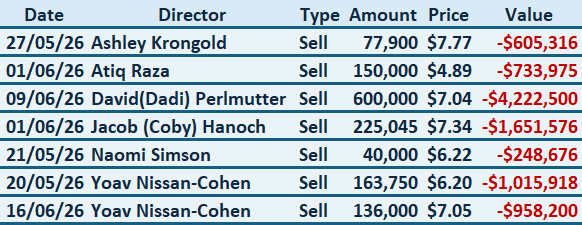
Weebit Nano was one of the quarter's largest insider selling stories, with six directors collectively selling $9.4 million worth of shares.
Importantly, the selling came after an extraordinary share price run. The stock had risen almost 130% over three months and more than 400% over the past year, making it one of the market's strongest performers.
The sales were spread across six insiders, including David (Dadi) Perlmutter, Jacob (Coby) Hanoch, Atiq Raza, Ashley Krongold, Naomi Simson and Yoav Nissan-Cohen. Given the magnitude of the rally, the transactions appear more consistent with portfolio management and profit-taking than a coordinated loss of confidence.

Smartgroup (ASX: SIQ): Mixed signals as founders cash in
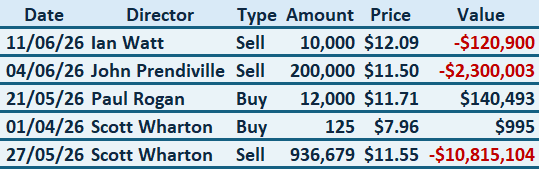
Smartgroup presents one of the more nuanced insider stories this quarter.
Net selling totalled $13.1 million, the largest dollar value of any company in the dataset, driven primarily by substantial sales from Scott Wharton (approximately $10.8 million) and John Prendiville (approximately $2.3 million).
However, the picture wasn't entirely one-sided. Director Paul Rogan purchased around $140,000 worth of shares during the quarter, while Scott Wharton also acquired a small parcel earlier in April.
Although the company ultimately qualifies as a net seller, the presence of both buying and selling suggests directors may have had differing motivations, with the larger transactions likely reflecting personal portfolio management following a share price that had climbed almost 76% over the previous year.

Fundie view
On a May episode of Buy Hold Sell, 1851 Capital's Chris Stott nominated SIQ as a stock that's flying under the radar. He said the following;
So, a price earnings ratio of 15 times, growing at low double digits we believe over the next few years, really strong balance sheet, great management team. And we think that people are underestimating the growth in novated lease space over the next two to three years, with the take-up of electric cars. It's an absolute no-brainer to use a novated lease from an after-tax perspective for anyone out there who fits the criteria. So we think that Smartgroup is probably the most well-positioned out of all the ASX companies in that space. So that's a strong buy for us.
The reader poll attached to that episode saw 54% of 329 voters rate SIQ a BUY, whilst 26% said HOLD, and 20% said SELL.
Never miss an update
Enjoy this wire? Hit the ‘like’ button to let us know.
Stay up to date with my current content by
following me below and you’ll be notified every time I post a wire
My passion is equity research, portfolio construction, and investment education. There are some powerful processes that can help all investors identify great opportunities and outperform the market, and I want to bring them to life and share them with you.
........
Livewire gives readers access to information and educational content provided by financial services professionals and companies ("Livewire Contributors"). Livewire does not operate under an Australian financial services licence and relies on the exemption available under section 911A(2)(eb) of the Corporations Act 2001 (Cth) in respect of any advice given. Any advice on this site is general in nature and does not take into consideration your objectives, financial situation or needs. Before making a decision, please consider these and any relevant Product Disclosure Statement. Livewire has commercial relationships with some Livewire Contributors.

4 topics
4 stocks mentioned

My passion is equity research, portfolio construction, and investment education. There are some powerful processes that can help all investors identify great opportunities and outperform the market, and I want to bring them to life and share them...
Expertise
My passion is equity research, portfolio construction, and investment education. There are some powerful processes that can help all investors identify great opportunities and outperform the market, and I want to bring them to life and share them...
Expertise
Comments
Comments
Sign In or Join Free to comment