TOL - 26th Jun, 2026
This stock screen delivered an average return of 49% in a year. Here are six more ideas
Last year's simple value + growth screen provided strong results. I review the winners, the lessons, and six new ideas for the year ahead.
 Add us as a preferred Google source
I've long held the view that when it comes to stock picking (or ETF investing), simpler is often better.
To test that theory, I published a vanilla-as-can-be stock screen one year ago designed to identify companies that offered a combination of growth, value and income.
Importantly, it excluded technology stocks, banks and commodities, as the goal was to help investors uncover growth opportunities in less crowded parts of the market.
Companies needed to have forecast earnings per share (EPS) growth above 10%, a price-to-earnings ratio below 20, pay a dividend and be rated fair or undervalued by Morningstar.
From that universe, I selected six companies and applied a second layer of journalistic analysis - I reviewed recent announcements, investor presentations, broker notes and news coverage to check if the growth narrative being presented to investors was supported by the data.
One year later, the results are in.
Results and analysis
The six stocks generated an average return of 49%, led by industrial giant Cummins (NYSE: CMI), salary packaging provider Smartgroup (ASX: SIQ) and infrastructure services company Ventia (ASX: VNT). Even the weakest performer, retailer Universal Store Holdings (ASX: UNI), still delivered a positive return.
The total returns are shown in the table below.

The three ASX companies from the screen also paid attractive franked dividends. This time last year, Universal Store yielded 4.8% fully franked, Ventia 4.2% (80% franked) and Smartgroup 5.3% fully franked, meaning returns were a bit higher than the share price gains shown above.
Smartgroup was particularly generous, paying a special 12-cent dividend on top of its 21.5-cent interim dividend in March 2026.
The international stocks also rewarded income investors. While they don't offer franking credits, their dividends tend to be more secure and grow more consistently.
Cummins lifted its dividend by 10%, marking its 16th consecutive annual increase, while Canadian National Railway extended its streak of rising payouts to 30 years with a further 3% lift.
Before presenting the new ideas, it's worth touching on our gold, silver and bronze medallists and why they performed so well:
🥇 Cummins (+130.1%) was the standout performer. Its Power Systems division, which supplies power generation equipment to data centres, continued to benefit from surging AI-related demand. Strong growth in the business helped drive upgrades to revenue and profit guidance.
🥈 Smartgroup (+80.4%) felt like a calculated fluke, to be honest, but the screen did a good job of exposing a mispriced opportunity. Much of the gain came in the weeks leading up to this update as regulatory uncertainty around novated leasing was removed. 1851 Capital's Chris Stott said on Buy Hold Sell last month that regulatory clarity has been "very, very favourable" for Smartgroup and this was a key reason he rated the stock a Strong Buy.
🥉 Ventia Services (+38.1%) continued to benefit from infrastructure spending tailwinds and a steady stream of contract wins across defence, telecommunications, transport and social infrastructure. Work on hand increased to almost $22 billion, supporting continued earnings growth, strong cash generation and a growing dividend.
Important note before revealing the next stocks
I want to stress that this exercise is illustrative and not a recommendation.
Too often, investors either blindly trust stock screens or blindly trust management. My aim was simply to show how combining data with a bit of research can uncover interesting opportunities and build a case for them - or not.
Many companies were excluded from both the original and updated screens. If I couldn't understand the business, or management's story didn't stack up against the numbers, the stock didn't make the cut. A screen is always just a starting point.
3 ASX DIVERSIFIERS
Like last year, I focused on opportunities outside the ASX 20 that offered a combination of growth, income and reasonable valuations. Using HALO data, I applied the following updated criteria:
- Exclude technology, banks and resources: These sectors already dominate most Australian equity portfolios and major indices.
- Forward EPS growth above 10%: The idea is to find genuine growth businesses, not value traps.
- Current PE ratio below 20: In a world where Commonwealth Bank trades like a technology stock, we want valuations grounded in reality.
- Pays a dividend: To cater to income-focused investors.
- EPS growth in each of the past three years (new filter): Evidence that growth is already being delivered, not merely forecast.
- More than 50% of covering brokers rate the stock a Buy or Outperform (new filter): Independent support for the investment case.
Here are the stocks that made the cut:
#1. AUB Group (ASX: AUB)
What it does: AUB Group is one of Australasia's largest insurance broking and underwriting businesses, with operations spanning retail insurance broking, agencies and underwriting, and risk services. It also owns equity stakes in a network of partner businesses across Australia, New Zealand and, increasingly, the UK.
Why it fits: A high-quality financial services business with a long track record of earnings and dividend growth, exposure to resilient insurance markets and a valuation that has become more attractive following a difficult year for the share price.
Key metrics:
- Industry: Insurance brokers
- PE ratio: 17.7
- EPS growth (FWD): 15.8%
- Dividend yield: 3.3% (100% franked)
- Market cap: $3.69 billion
- Consensus rating: 33% Buy, 50% Outperform, 17% Neutral, 0% Sell
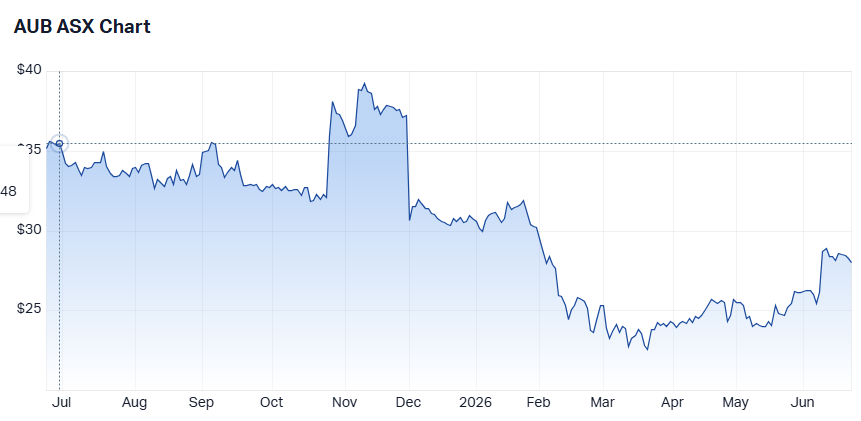
What's happening with the stock: AUB's shares have fallen around 20% over the past year due to concerns about AI disruption and dilution from the company's $432 million acquisition of UK-based Prestige. The stock was also buoyed by a takeover approach from Swedish private equity giant EQT before a deal ultimately failed to materialise.
Despite this, management recently upgraded FY26 profit guidance and believes the Prestige acquisition will help scale its UK operations, unlock cross-selling opportunities and deliver $10 million in synergies.
AUB also appears to be embracing AI rather than fearing it, outlining plans to use the technology across customer service, contract reviews and quote generation.
If management can successfully execute its UK expansion strategy, the recent sell-off may prove an opportunity rather than a warning sign. It must be stressed, however, that many Australian companies have found it hard to succeed in Britain (NAB and QBE among them).
#2. Brambles (ASX: BXB)
What it does: Brambles operates the world's largest pallet pooling network through its CHEP brand. The company supplies reusable pallets, crates and containers to manufacturers, retailers and distributors across more than 60 countries.
Why it fits: A global industrial leader with a highly defensive business model, recurring revenue, attractive dividend yield and a long track record of earnings growth.
Key metrics:
- Industry: Industrials
- PE ratio: 19.98
- EPS growth (FWD): 10.64%
- Dividend yield: 3.38% (20% franked)
- Market cap: $25.62 billion
- Consensus rating: 33% Buy, 20% Outperform, 47% Neutral
What's happening with the stock: Brambles' shares have fallen around ~15% since May, after the company revealed it couldn't find enough workers in the US to repair its wooden pallets quickly enough to meet customer demand, forcing management to downgrade its sales and earnings outlook.
To its credit, management was transparent about the issue, outlined a remediation plan and simultaneously launched a US$400 million share buyback.
This is where going beyond the screen becomes important. In a recent Buy Hold Sell episode, Yarra Capital's Marcus Ryan rated Brambles a Sell, arguing the valuation offered "little margin of safety" given the operational risks facing the business.
Still, management expects margins to improve as the issues are resolved, while the buyback provides meaningful support for the EPS metric. Investors will need to decide whether the recent sell-off has created an opportunity or simply exposed further downside risk.

#3. ResMed (ASX: RMD)
What it does: ResMed is a global medical technology company specialising in sleep apnoea, respiratory care and digital health solutions. Its devices and software help millions of patients manage chronic sleep and breathing disorders.
Why it fits: A global healthcare leader with strong market share, recurring revenue, double-digit earnings growth and a valuation that has become more attractive following a broad sell-off in healthcare stocks.
Key metrics:
- Industry: Healthcare
- PE ratio: 18.18
- EPS growth (FWD): 17.57%
- Dividend yield: 0.91% (unfranked)
- Market cap: $39 billion
- Consensus rating: 55% Buy, 16% Outperform
What's happening with the stock: Healthcare names like ResMed have fallen out of favour globally as investors grapple with policy uncertainty, pressure on health insurers and a market that continues to reward cyclical and AI-related growth stories.
ClearBridge's Reece Birtles recently told Livewire that ResMed offers compelling value for its growth prospects, nominating it as a top FY27 pick.
"Having looked at this stock over the last 20 years, there have probably only been three really good valuation opportunities to buy it. At 16 times earnings for double-digit growth, we think it's been mispriced in the current market and should do well ahead," he said.

3 INTERNATIONAL DIVERSIFIERS
For international companies, I applied the same screening criteria but limited the universe to U.S. and Canadian companies listed on U.S. exchanges, reflecting the fact that the United States remains the most popular destination for Australians investing offshore.
I also increased the minimum market capitalisation to US$10 billion to focus on larger, more established businesses.
#1. Assurant (NYSE: AIZ)
What it does: Assurant provides insurance and protection products for mobile phones, vehicles, appliances and connected devices. Its services are embedded with major carriers, manufacturers and retailers, helping consumers repair, replace and protect their purchases.
Why it fits: A defensive insurance business with a long track record of earnings growth, shareholder returns and exposure to recurring consumer spending rather than economic cycles.
Key metrics:
- Industry: Property & casualty insurance
- PE ratio: 13.40
- EPS growth (FWD): 21.67%
- Dividend yield: 1.32%
- Market cap: US$12.96 billion
- Consensus rating: 43% Buy, 14% Outperform
What's happening with the stock: Assurant enters the screen with momentum, up 31% over the past year. Despite flying under the radar for most investors, the company recently reported its "strongest quarter in history" and 10th consecutive year of profitable growth, driven by double-digit growth across its Global Lifestyle and Global Automotive businesses.
The company also highlighted a major customer win with a "leading Australian mobile carrier", while extending its streak of annual dividend increases to 21 years.
Management is guiding to single-digit revenue growth in 2026, but ongoing buybacks should help drive stronger EPS growth. Assurant won't excite many investors, but it looks like the sort of steady compounder that can diversify a portfolio.

#2. Crown Holdings (NYSE: CCK)
What it does: Crown Holdings is one of the world's largest manufacturers of metal packaging, supplying beverage cans, food cans and aerosol containers to consumer goods giants including PepsiCo, Coca-Cola, Heineken and WD-40.
Why it fits: A relatively overlooked industrial business that offers exposure to long-term growth in consumer staples without having to pick winning beverage or food brands.
Key metrics:
- Industry: Industrials - packaging
- PE ratio: 16.41
- EPS growth (FWD): 26.69%
- Dividend yield: 1.20%
- Market cap: US$11.53 billion
- Consensus rating: 50% Buy, 21% Outperform
What's happening with the stock: Crown's share price has gone nowhere over the past five years, but management believes the business is entering a stronger growth phase as tariff concerns ease. The company is investing US$550 million to expand capacity in Brazil, Greece and Spain, where demand for canned beverages continues to grow.
What makes Crown interesting is that it's largely trend-agnostic. Investors in beverage manufacturers need to predict whether consumers will favour beer, soft drinks, energy drinks or sparkling water. Crown simply supplies the can.
The company has also spent years reducing debt, pushing net leverage to its lowest level in 15 years and giving management confidence to increase its latest quarterly dividend by 35%.
It isn't an explosive growth business, but a stronger balance sheet, rising dividends and a reasonable valuation make it an interesting way to play the steady growth in consumption.

#3. BNY (NYSE: BNY)
What it does: BNY, formerly known as Bank of New York Mellon, is the world's largest custodian bank, safeguarding and administering assets on behalf of asset managers, pension funds, governments and institutions. The company oversees ~US$60 trillion of assets and serves some of the world's largest investment firms, including BlackRock and Morgan Stanley.
Why it fits: A financial infrastructure business with recurring revenues, double-digit earnings growth and a valuation that remains reasonable despite its dominant market position.
Key metrics:
- Industry: Banks - Diversified
- PE ratio: 18.17
- EPS growth (FWD): 17.5%
- Dividend yield: 2.12%
- Market cap: US$100.51 billion
- Consensus rating: 43% Buy, 14% Outperform
What's happening with the stock: While the screen excluded traditional banks, it didn't exclude financial services businesses, and BNY is a very different beast to our Big Four. The company touches roughly 20% of the world's investable assets and earns a small fee for helping service them.
In some ways, it's similar to Crown Holdings. Fund managers create the products and investment trends; BNY helps keep them packaged in the fund or ETF wrapper and administered on behalf of investors.
The company recently reported 13% revenue growth, a return on equity of 16.1% and EPS growth of 42%, while authorising a US$10 billion buyback program - equivalent to roughly 10% of its market capitalisation.
Investors have taken notice. The shares are up more than 60% over the past year and more than 200% over the past five years - not bad for a company most people have never heard of.
As asset values rise and more money flows into investment products, BNY's fee pool tends to grow as well. For investors seeking exposure to financial services without traditional lending risk, it's an interesting business to consider.

Thoughts on this year's list
Hopefully this exercise shows one way investors can combine stock screens with a healthy dose of scepticism and common sense.
While I've narrowed the list to six stocks, I haven't discussed the 50-plus companies that were discarded along the way. Some operated in businesses that were too complex to understand quickly, some lacked a compelling growth story, and others simply didn't have management teams backing up the numbers.
I'll also admit that last year's list was probably more exciting. Stocks such as Ventia, Smartgroup and Cummins felt genuinely mispriced and had powerful tailwinds behind them. After another strong year for equity markets, finding growth at a reasonable price has become more difficult.
That doesn't mean opportunities don't exist. Each of the companies above has a credible investment case. But as always, investors should focus not only on the upside, but also on their margin of safety if things don't go to plan.
See the original analysis below

Equities
6 ASX and global stocks to rebalance your portfolio from banks, miners and tech
View
Never miss an update
Enjoy this wire? Hit the ‘like’ button to let us know.
Stay up to date with my current content by
following me below and you’ll be notified every time I post a wire
I have over 15 years’ experience covering financial markets and property, with a particular interest in ETFs and personal finance. I split my time between Australia and Canada to bring a global perspective to my work.
........
Livewire gives readers access to information and educational content provided by financial services professionals and companies ("Livewire Contributors"). Livewire does not operate under an Australian financial services licence and relies on the exemption available under section 911A(2)(eb) of the Corporations Act 2001 (Cth) in respect of any advice given. Any advice on this site is general in nature and does not take into consideration your objectives, financial situation or needs. Before making a decision please consider these and any relevant Product Disclosure Statement. Livewire has commercial relationships with some Livewire Contributors.

3 topics
9 stocks mentioned

I have over 15 years’ experience covering financial markets and property, with a particular interest in ETFs and personal finance. I split my time between Australia and Canada to bring a global perspective to my work.
Expertise
I have over 15 years’ experience covering financial markets and property, with a particular interest in ETFs and personal finance. I split my time between Australia and Canada to bring a global perspective to my work.
Expertise
Comments
Comments
Sign In or Join Free to comment