TOL - 29th Jun, 2026
9 all-weather ASX stocks for whatever the market brings next
What makes an all-weather stock? We built a screen, found some contenders, and checked it with FN Arena's Rudi Filapek-Vandyck.
 Add us as a preferred Google source
This too shall pass.
Whilst markets are flying now, the good times won’t last forever – they never do. Whether it’s a liquidity event, an IPO-frenzy-driven meltdown, or simply a well-ordered retreat, markets will pull back eventually.
I’m no Chicken Little, and the sky is not falling, but planning for what will undoubtedly arrive at some point is always a worthwhile undertaking.
For those in equities, the options are pretty straightforward – sell everything and run for the hills, sell all your growth stocks and go completely defensive, or build a portfolio of all-weather stocks that will participate in some of any future upside, whilst at the same time providing some protection for when markets fall.
That last approach is the focus of this wire. Below, I unpack the history of all-weather investing, build a basic scan to screen for stocks, and then lean on the experience of FN Arena's Rudi Filapek-Vandyck, who has been running an all-weather portfolio for decades.

Quick history lesson
The 'All Weather' investment approach was developed by Bridgewater founder Ray Dalio in the 1990s as a way of constructing portfolios that could withstand different economic environments. Rather than trying to predict inflation, growth, recessions or market shocks, the strategy diversified across assets expected to perform under each scenario.
Whilst Dalio's framework focused on asset allocation rather than stock selection, the underlying principle is highly relevant to equities: identify businesses capable of creating value across a wide range of economic conditions.
The concept has since been expanded to stocks, although agreement on exactly what constitutes an all-weather stock has been elusive. Some investors focus on dividends. Others look for earnings growth, low debt or defensive sectors. Yet a large body of academic and practitioner research points to something slightly different.
Research from Eugene Fama and Kenneth French on profitability, Cliff Asness and AQR’s work on the quality factor, and books such as Quality Investing by Lawrence Cunningham, Patrick Hargreaves and Torkell Eide all arrive at broadly similar conclusions.
Research consistently finds that companies with high profitability, strong margins, resilient earnings and the ability to reinvest capital at attractive rates of return tend to outperform over long periods.
In other words, the best businesses are often distinguished not by how fast they grow in any single year, but by how consistently they create value across multiple economic environments.
Rudi puts it more succinctly.
"The label says it all: an All-Weather performer is able to grow shareholder wealth under most circumstances; come hail, rain, wind or sunshine.
Success stories usually have a strong market positioning, protected by a moat, or a leading product or technology, outside of hyper-cyclical industries, and seldom a cheap valuation (generally, one excludes the other)".
With all that in mind, I set out to build a simple screening model to identify the ASX’s most likely all-weather candidates.
The challenge was that I was constrained by the factors available in my screening tool. Ideally, I would have examined five to ten years of data, looking for companies that consistently generated high returns on capital, maintained margins through recessions and expansions, and produced reliable free cash flow over long periods. Those are the characteristics most commonly associated with quality businesses in the academic literature.
Unfortunately, those historical measures were not available. Instead, I focused on five metrics that best aligned with the research.
#1 - EPSg 10yr Hist > 5%
Of all the factors available, 10-year historical earnings growth was arguably the most important. A company that has grown earnings by more than 5% annually over a decade has already navigated different interest-rate cycles, market corrections, commodity shocks and economic slowdowns, making it a useful proxy for resilience.
#2 - EPSg 1yr Fwd > 5%
Historical growth was prioritised, but I also wanted some evidence that growth could continue. Forecast earnings growth above 5% was included as a simple check that the market expects the business to keep moving forward, although this factor can favour cyclical companies during earnings recoveries.
#3 - EBITDA Margin 1yr Fwd > 5%
Profit margins are a useful proxy for pricing power and competitive advantage. A hurdle of 5% removes many low-quality businesses while remaining broad enough to capture companies across a range of sectors.
#4 - ROE 1yr Fwd > 10%
Return on equity measures how effectively a company generates profits from shareholder capital. A hurdle of 10% was chosen to identify businesses with above-average profitability without making the screen so restrictive that it excluded otherwise high-quality companies.
#5 - Market Capitalisation > $2 billion
Larger companies often benefit from greater scale, more diversified revenue streams and better access to capital during periods of economic stress. Setting the threshold at $2 billion excludes smaller, more speculative businesses while retaining a broad investment universe.
Far from perfect
The screen was far from perfect. A total of 48 companies made the cut, but several commodity producers appeared, as cyclical businesses often look exceptionally attractive when earnings are rebounding.
Screening tools also struggle to capture some of the qualitative traits that define truly durable businesses, such as brand strength, network effects, switching costs, management quality and corporate culture. That meant the screen was only the starting point, not the final answer - and why I engaged Rudi to check my homework.
After reviewing the results, eight companies stood out as the strongest combination of quality, resilience and long-term durability. They operate in different industries, but all share characteristics commonly associated with businesses that can continue creating value regardless of whether the economy is booming, slowing or somewhere in between. For good measure, Rudi adds another name, making nine all-weather stocks to consider in total.
Let’s take a closer look at each of them.
The stock picks

#1 - Aristocrat Leisure (ASX: ALL)
Aristocrat fits an all-weather profile because it combines a dominant, high-return land-based gaming franchise with growing digital earnings from social casino and online gaming. That mix has helped it grow through different operating conditions rather than relying on one market. Profitability remains exceptional, and Product Madness is still winning share even in a soft social-casino market.

Aristocrat was recently featured in this Livewire article as one of the top 15 ASX wealth creators over the past decade. At the start of this year, Airlie Funds Management's Matt Williams highlighted ALL as a winner of the next cycle, arguing that "the company's gaming operations business (in which it places slot machines on casino floors and shares in the revenue) is akin to an infrastructure business".
"If the content remains popular, Aristocrat can dominate this sector for another decade at least," added Williams.
Rudi's take
ALL is currently held in the FNArena-Vested Equities All-Weather Model Portfolio.
Australia has a gambling addiction problem, but this global giant’s fortunes are
closely linked to North America where four-fifth of FY25 sales were made.
Aristocrat is no longer just about pokie machines; we’re now talking about a global gaming-content and technology group, also including casino systems, social casino games, online real-money gaming, and iLottery.
Whenever some misguided commentary reaches my ear about Australia’s large-cap companies lacking ‘growth ’, I casually refer to Aristocrat.
Without the slightest doubt one of the prime growers in Australia, making most smaller caps equally jealous.
#2 - Amcor (ASX: AMC)
Amcor fits the all-weather brief because packaging demand is tied to everyday end-markets such as food, beverage, healthcare, beauty and home care, not one-off consumer splurges. Its scale, customer entrenchment and cash generation make earnings steadier than most industrials, while management is actively reshaping the portfolio toward faster-growing, higher-margin consumer packaging.

On a recent episode of Buy Hold Sell, IML's Michael O'Neill rated Amcor a BUY, saying the following;
"The buy case for Amcor is their Berry Global merger. That should see them taking out $530 million of cost synergies. Some of it is low hanging fruit like procurement and that should underpin 34% earnings growth cumulatively over the next three years."
The reader poll attached to that episode saw 32% of 766 voters rate AMC a BUY, whilst 46% said HOLD, and 22% said SELL.
#3 - Computershare (ASX: CPU)
Computershare qualifies because it runs market-critical infrastructure - share registry, corporate trust and employee share plans - with long client relationships, global scale and low capital intensity. Earnings are diversified across fee pools and margin income, and management explicitly frames the model as capable of delivering high returns through cycles while managing rate sensitivity.

On a May episode of Buy Hold Sell, both Julia Weng from Paradice Investment Management and Hamish FitzSimons from AllianceBernstein rated CPU a BUY, with the former saying the following;
"We’re seeing pipelines building for IPOs, especially in Hong Kong. Debt issuance grows at roughly mid-single digits, and companies are still adopting more employee share plans as a way of retaining and keeping employees aligned with them for longer. We think Computershare is well placed and certainly could harness AI to have productivity benefits over the next few years."
The reader poll attached to that episode saw 54% of 338 voters rate CPU a BUY, whilst 33% said HOLD, and 13% said SELL.
#4 - Medibank Private (ASX: MPL)
Medibank combines defensive earnings with predictable cash flow. Health insurance demand remains resilient through economic cycles, while an ageing population provides a long-term growth tailwind. Strong margins, a debt-light balance sheet and reliable dividends make Medibank one of the ASX's more dependable all-weather businesses.

In a recent wire from yours truly focusing on healthcare opportunities, Wilson Asset Management's Anna Milne said the following about MPL:
"Medibank offers a compelling proposition on a 3-5 year view. Mid-single-digit revenue and earnings growth combined with a 4% dividend yield provides a robust total return."
#5 - Goodman Group (ASX: GMG)
Goodman looks all-weather because it owns and develops logistics estates and data-centre infrastructure in supply-constrained global cities, backed by one of the strongest balance sheets in listed property. The model blends recurring rental and management income with development profits, while its capital-partner platform provides flexibility that most REITs lack.

Rudi's take
GMG is currently held in the FNArena-Vested Equities All-Weather Model Portfolio.
One all-important GFC lesson learned has created a local giant in developing industrial property assets, by now, with a large skew towards data centres.
Its portfolio includes warehouses, distribution centres, business parks and data centres across 15 countries.
One of the most successful international growth stories on the ASX, but Goodman is also the largest constituent in the local REIT index, and valued as a reliable growth achiever in that low-growth, bond-proxied sector.
The latter is the problem for many; they don’t know how to ‘value’ it.
#6 - ResMed (ASX: RMD)
ResMed combines structural growth in healthcare with highly recurring demand. As a global leader in sleep apnoea treatment, it benefits from ageing populations, rising diagnosis rates and strong pricing power, helping it deliver consistent earnings growth through a range of economic conditions.

Rudi's take
RMD is currently held in the FNArena-Vested Equities All-Weather Model Portfolio.
Not always appreciated locally, but whenever tables are compiled of the best performers on Wall Street over the past 2-3 decades, ResMed usually features prominently.
Not recently, though. Ever since the introduction of GLP-1s, the ResMed share price has faced periods of overwhelming selling pressure. Plus healthcare, globally, remains on the nose.
Operationally, ResMed remains the global leader in what remains a structurally undiagnosed ailment. Growth won’t be double-digit every year, but there should still be plenty of it on the horizon.
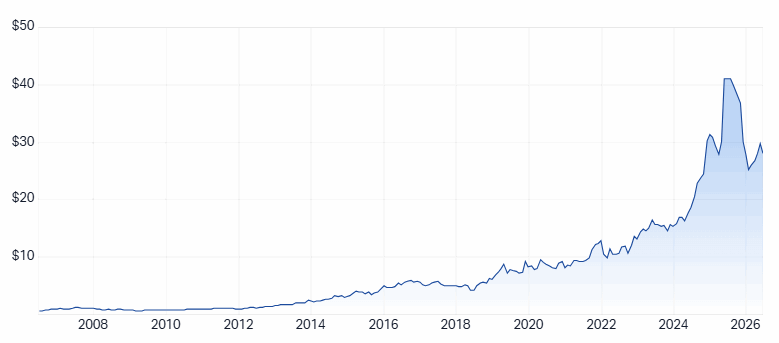
#7 - Technology One (ASX: TNE)
TechnologyOne's cloud-based software model generates highly recurring revenue and exceptional customer retention. Its mission-critical products, long-term growth runway and track record of steadily compounding earnings have helped it become one of the ASX's most durable technology businesses.
Rudi's take
TNE is currently held in the FNArena-Vested Equities All-Weather Model Portfolio.
Tech1 is the tortoise in a playground where hares run riot. Growth is never spectacular, but extremely consistent.
Growing at 10% per year means a business doubles in size every 7.2 years. Tech1 does better; hence, it doubles in less than 5 years.
I wouldn’t bet against it doing exactly that, in particular after the global software de-rating.
Without any doubt, the prime example of a true blue All-Weather on the ASX.
#8 - Woolworths (ASX: WOW)
Woolworths is one of the clearest all-weather names on the ASX because grocery demand is inherently defensive: households keep buying food in downturns. Scale strengthens pricing, procurement and distribution, while eCommerce, media, rewards and services are building higher-growth earnings streams around a highly resilient supermarket core.

Rudi's take
WOW is currently held in the FNArena-Vested Equities All-Weather Model Portfolio.
In Australia, the duopoly of Woolworths and Coles supermarkets remains a central force to be reckoned with, as also illustrated by the latter’s share price trading at an all-time record high.
Woolworths is the number one in size, and for a long while it has outperformed from this strong position. In recent years, the pendulum has swung in Coles’ favour.
Here’s a lesson for investors: when hubris enters management and the board, even the best of companies can lose their mettle.
Can Woolworths claw its way back? When avoiding hubris at the top and taking guidance from the past, the answer should be 'yes'.
#9 - Rudi's bonus stock - Macquarie Group (ASX: MQG)
MQG is currently held in the FNArena-Vested Equities All-Weather Model Portfolio.
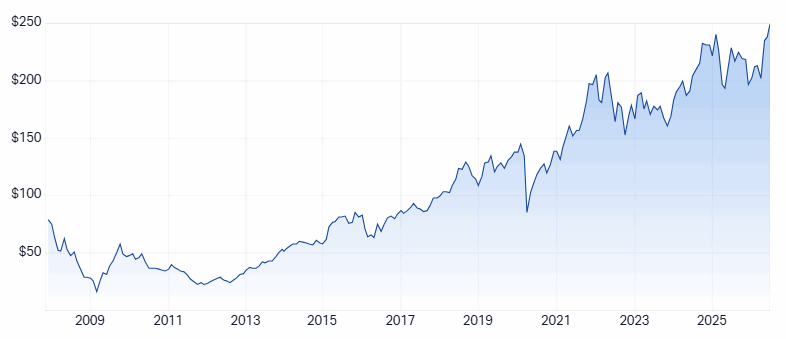
Australia’s own millionaires' Dream Machine! That favourable track record reflects the culture and the drive internally, more so than the businesses of asset management, banking, wealth management, advisory, et cetera.
More than any other company on the ASX that can be considered a High Quality performer, Macquarie relies on humans.
What this shows is that there’s no single formula to make it work.
Over to you
There you have it: nine all-weather stocks to add to your watchlist. It was encouraging to see some overlap (five stocks) between the names generated by the scan and those held by Rudi in his all-weather portfolio.
And whilst Macquarie Group was not picked up by the scan, it has been a favourite of mine for a decade, dating back to my analyst days, and it's hard to argue with Rudi's assessment.
Do you have any all-weather stocks that have delivered for you over the journey? Let us know in the comments section below.
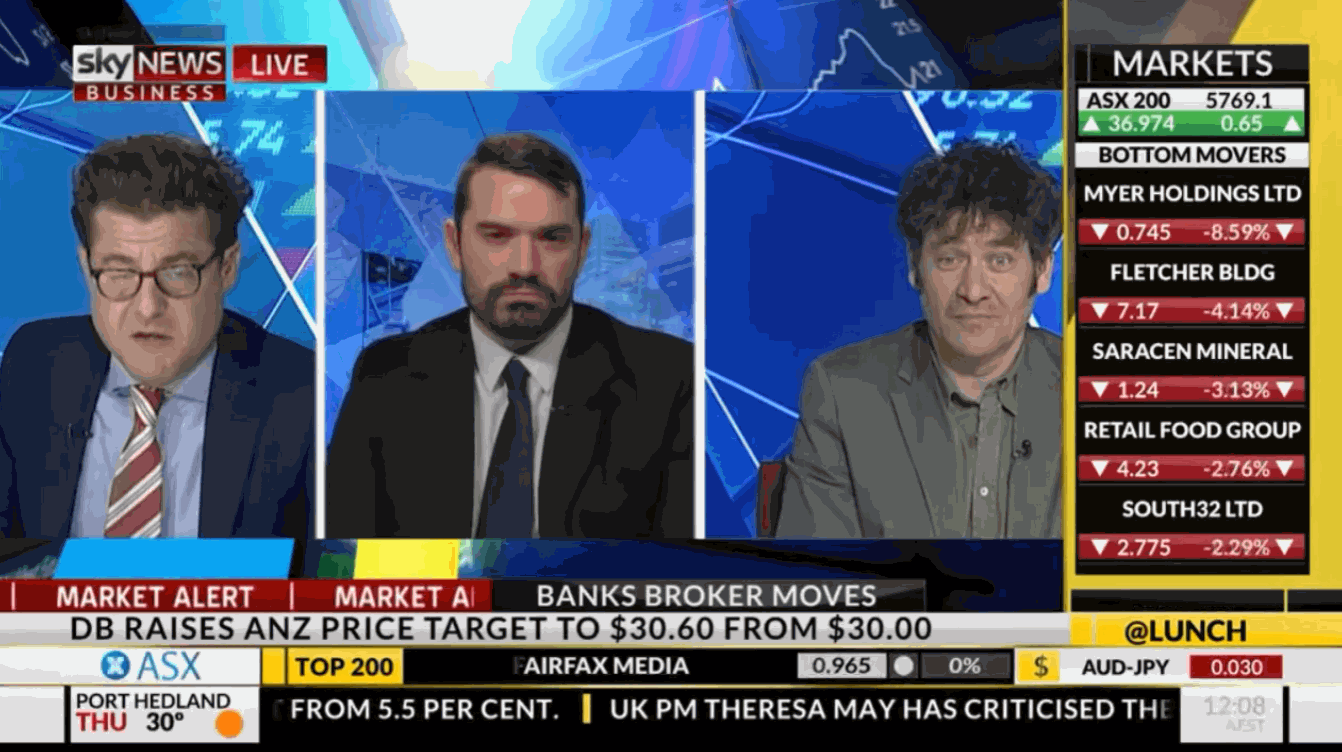
PS - for a bit of fun, here's one from the archives. That's Rudi and I appearing on Sky Business back in 2017. Not sure what was being said, but neither of us looked too impressed: must have been a non all-weather stock Carson was asking us about.
Never miss an update
Enjoy this wire? Hit the ‘like’ button to let us know.
Stay up to date with my current content by
following me below and you’ll be notified every time I post a wire
My passion is equity research, portfolio construction, and investment education. There are some powerful processes that can help all investors identify great opportunities and outperform the market, and I want to bring them to life and share them with you.
........
Livewire gives readers access to information and educational content provided by financial services professionals and companies ("Livewire Contributors"). Livewire does not operate under an Australian financial services licence and relies on the exemption available under section 911A(2)(eb) of the Corporations Act 2001 (Cth) in respect of any advice given. Any advice on this site is general in nature and does not take into consideration your objectives, financial situation or needs. Before making a decision, please consider these and any relevant Product Disclosure Statement. Livewire has commercial relationships with some Livewire Contributors.

5 topics
9 stocks mentioned

My passion is equity research, portfolio construction, and investment education. There are some powerful processes that can help all investors identify great opportunities and outperform the market, and I want to bring them to life and share them...
Expertise
My passion is equity research, portfolio construction, and investment education. There are some powerful processes that can help all investors identify great opportunities and outperform the market, and I want to bring them to life and share them...
Expertise
Comments
Comments
Sign In or Join Free to comment