TOL - 27th Aug, 2026
The brutal new maths of saving for a house deposit
Saving for a house is hard enough. We crunched the numbers to see how much harder the new tax rules could make it.
 Add us as a preferred Google source
Saving for a house deposit has become increasingly difficult as house prices and rents have risen, prompting many Australians to invest in shares and ETFs to help accelerate the journey.
But from 1 July 2027, the tax treatment of those investments is set to change, with the 50% CGT discount replaced by cost-base indexation and a minimum 30% tax rate on capital gains.
So, could the new tax system make it take longer to save for a house?
I asked Stockspot founder and CEO Chris Brycki to crunch the numbers.
Brycki built a calculator to model the journey under both tax systems and was kind enough to share it with us, allowing us to test different incomes, savings rates, rents and property prices.
How the calculator works

For each scenario, the model assumes:
- The buyer saves and invests a set proportion of their after-tax income while renting.
- Their savings are invested in a high-growth portfolio expected to return 10% a year, comprising 7% capital growth and 3% income.
- Wages, rent and house prices change each year based on the assumptions for each buyer.
- They're aiming for a 20% deposit, which rises as the value of their target property increases.
- Once their portfolio is large enough, they sell their investments and pay the applicable CGT.
- Under the current rules, they receive the 50% CGT discount. Under the new rules, the cost base is indexed to inflation and the 30% minimum tax rate applies.
- One final assumption: the Bank of Mum and Dad is closed. We have excluded parental gifts or contributions from these calculations, recognising that not everyone is fortunate enough to have that support.
The model then calculates when the buyer has enough after-tax proceeds to fund the deposit.
Scenario 1: The average-income couple
Brycki started with two full-time earners on average weekly earnings, giving them a combined gross income of around $213,000 a year. They save and invest 15% of their after-tax income while renting and are targeting a 20% deposit on a $1.1 million property, broadly in line with the national average.
The assumptions
- Household gross income: $213,000
- Starting annual savings: ~$24,500 (15% of after-tax income)
- Starting rent: $700 a week
- Target house price: $1.1 million
- Deposit: 20%
- Wage growth: 3% p.a.
- House price growth: 3% p.a.
- Rent growth: 3.5% p.a.
- Starting savings: $0
So, how much difference does the tax change actually make?
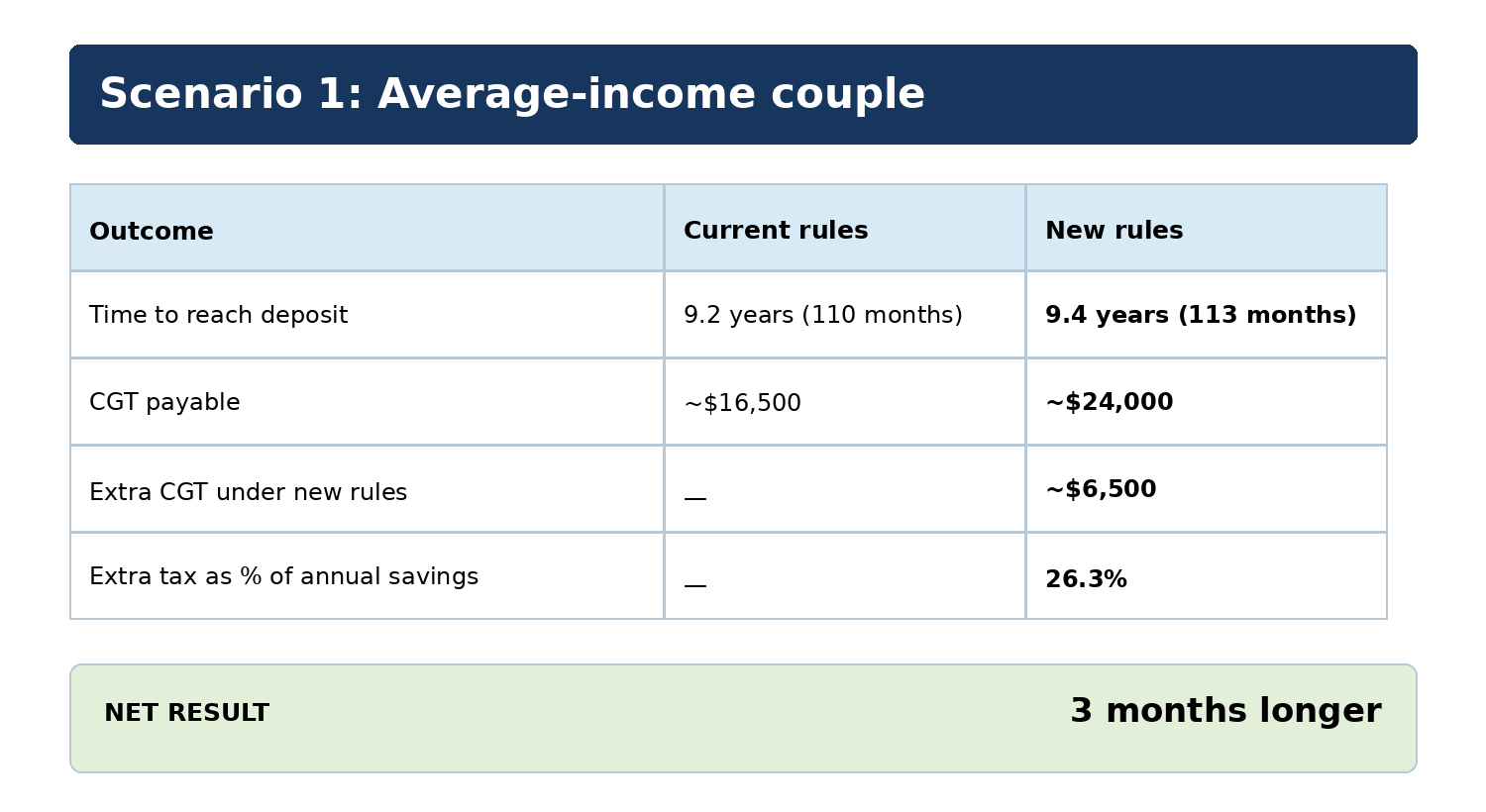
For this couple, the difference is relatively modest. The new rules add three months to the time required to reach their deposit. The additional CGT under the new system is around $6,500, equivalent to 26.3% of their starting annual savings.
Scenario 2: The $400,000 couple
For our second scenario, I used the circumstances of one of my best friends and his partner, who have a combined household income of just over $400,000.
They’re hoping to buy a house in Sydney’s Northern Beaches for around $2.5 million. Despite their high income, they’re starting their deposit journey with no savings and currently pay $1,000 a week in rent. Their target price also puts them beyond the reach of the 5% Deposit Scheme, which caps eligible NSW properties at $1.5 million.
The assumptions
- Household gross income: $405,600
- Starting annual savings: $42,404 (15% of after-tax income)
- Starting rent: $1,000 a week
- Target house price: $2.5 million
- Deposit: 20%
- Wage growth: 3% p.a.
- House price growth: 4% p.a.
- Rent growth: 4.4% p.a.
- Starting savings: $0
Here's what the model produced.

In this case, the difference increases to 12 months. The additional CGT under the new rules is around $51,000, equivalent to 120.3% of the amount they're initially saving and investing each year.
Scenario 3: The single Sydneysider
Our final scenario comes from a colleague's friend is trying to buy on a single income of around $120,000, with $50,000 already saved and invested.
Under our original assumptions, which assumed 4% annual house price growth, she never reached a 20% deposit because the amount she needed was growing faster than her savings and investments could keep pace. We therefore modelled an $800,000 property with more modest annual price growth of 2%.
The assumptions
- Household gross income: $120,000
- Starting annual savings: $4,540 (5% of after-tax income)
- Starting savings: $50,000
- Starting rent: $730 a week
- Target house price: $800,000
- Deposit: 20%
- Wage growth: 3% p.a.
- House price growth: 2% p.a.
- Rent growth: 6.4% p.a.
Here's the result.

Under the current system, the model estimates it would take 18.3 years to reach the deposit. Under the new rules, that rises to 19.8 years – an additional 18 months. The additional CGT is around $24,100, equivalent to 530.5% of her starting annual savings.
Let's face it, it's tougher for home buyers
There are obvious limitations to these scenarios. They're illustrations, not predictions, and changing the assumptions around wages, rents, house prices or investment returns can materially change the outcome.
But there's a broader point in the numbers.
Saving for a deposit isn't simply about putting aside 20% of today's house price.
While our buyers are saving, they're also paying rent, the property they're chasing can become more expensive, and the deposit required rises with it. For those investing their savings to keep pace, how much they ultimately get to keep after tax matters. A lot.
"You can't measure housing affordability by house prices alone. What matters is whether people can afford the rent while saving and how quickly their deposit grows after tax," Brycki says.
Brycki argues this is why the time required to accumulate a deposit can be a useful test of housing policy.
"The real test of any housing policy is how long it takes someone to save a deposit. On that measure, higher rents and higher taxes on investment returns can leave first-home buyers worse off even if house prices are lower."
Geoff Wilson calls for tax-free investment account
.jpg)
Brycki’s modelling shows the near doubling of CGT through the move to indexation “leaves many aspiring homeowners worse off,” according to Wilson Asset Management Founder and Chair Geoff Wilson AO.
“They increase the tax on the growth assets young Australians use to build a deposit and, by discouraging investment in established rental housing, risk putting further upward pressure on the rent they pay while saving,” Wilson says.
Separate modelling from Derek Francis, former Chief Economist at the NSW Parliamentary Budget Office, shared by Wilson, suggests the impact could be significantly greater than in our Brycki scenarios when more modest investment returns are assumed.
Assuming a target deposit requirement of $100,000 in inflation-adjusted dollars:
- Under the Current CGT Framework, a young investor reaching a 5.8% real return can achieve their deposit goal in 12.3 years.
- Under the Proposed Budget Policy, with the real return lowered to 4.4%, reaching that same baseline deposit target takes 16.1 years.
- Because the higher tax rates slow down capital growth, it takes a young person exactly 3.8 years longer to build a standard first-home deposit pool. This represents a 30.9% longer accumulation period, forcing Gen Z and Millennials to remain in the rental market for nearly four additional years before they can achieve housing security.
.png)
"[The modelling] suggests the combined effect could delay a home deposit by nearly four years. That is not an abstract tax calculation - it is up to another four years of paying higher rents while house prices may continue moving further out of reach," Wilson says.
While Wilson has been a vocal critic of the tax changes, he offers a solution: give aspiring homeowners a tax-free way to build their deposit.
“The Australian Government 5% Deposit Scheme may help eligible buyers purchase sooner. However, no amount of skipping coffees can fully offset higher rents and a higher tax on investment returns.
The Government should establish a tax-free First Home Investment Account, allowing returns on savings and investments to compound free of capital gains tax when the proceeds are used to purchase a first home.”
For those saving for a home, Wilson says the fundamentals still matter: start early, automate savings and take advantage of every available concession, including the First Home Super Saver Scheme.
“Match your investment risk to your timeframe: money needed within the next few years should not be exposed to a sudden sharemarket fall; with a longer timeframe, regular investment in a diversified, low-cost portfolio can help savings compound.”
Want us to run your numbers?
Everyone's circumstances are different. If you'd like to know how the new tax rules might affect someone in a situation like yours, send us a hypothetical scenario.
Give us an income, starting savings, annual savings, rent, target property price and expected investment returns, and we'll do our best to run the numbers through Brycki's calculator and estimate how much longer it could hypothetically take to reach a deposit under the new system.
This modelling is illustrative only and depends on the assumptions used. Investment returns, wages, rents, inflation, property prices, individual tax circumstances and access to home-buyer assistance or deposit support will vary. The scenarios should not be interpreted as forecasts or personal financial advice.
Never miss an update
Enjoy this wire? Hit the ‘like’ button to let us know.
Stay up to date with my current content by
following me below and you’ll be notified every time I post a wire
I have over 15 years’ experience covering financial markets and property, with a particular interest in ETFs and personal finance. I split my time between Australia and Canada to bring a global perspective to my work.
........
Livewire gives readers access to information and educational content provided by financial services professionals and companies ("Livewire Contributors"). Livewire does not operate under an Australian financial services licence and relies on the exemption available under section 911A(2)(eb) of the Corporations Act 2001 (Cth) in respect of any advice given. Any advice on this site is general in nature and does not take into consideration your objectives, financial situation or needs. Before making a decision please consider these and any relevant Product Disclosure Statement. Livewire has commercial relationships with some Livewire Contributors.

2 topics
2 contributors mentioned

I have over 15 years’ experience covering financial markets and property, with a particular interest in ETFs and personal finance. I split my time between Australia and Canada to bring a global perspective to my work.
Expertise
I have over 15 years’ experience covering financial markets and property, with a particular interest in ETFs and personal finance. I split my time between Australia and Canada to bring a global perspective to my work.
Expertise
Comments
Comments
Sign In or Join Free to comment