TOL - 26th Aug, 2026
Vanguard's 6 shocking charts about retirement in 2026
Gen Z may miss a rite of passage Boomers took for granted: retiring mortgage-free. Vanguard's latest report reveals a generational divide.
 Add us as a preferred Google source
Vanguard's latest How Australia Retires report has landed, and if there's one message I took from this landmark research, it's this: the traditional Australian retirement is being rewritten.
For generations, the formula was relatively straightforward. Work, buy a home, pay off the mortgage, build your super and hopefully enter retirement debt-free.
That formula is looking increasingly shaky for younger generations - and sorry Gen Z, you're facing the brunt of it.
Vanguard surveyed more than 1,800 Australians and found younger generations expect to retire later, need considerably more income and, perhaps most concerningly, carry their mortgages much deeper into life.
But it's not all doom and gloom. One of my favourite charts in the report shows just how dramatically retirement confidence can change when someone starts planning and engaging with their finances.
I've gone through Vanguard's latest retirement report and picked the six charts that made me sit up and take notice.
Let's dive in.
1. Almost half of Gen Z expects to retire with a mortgage
This is the chart that immediately grabbed my attention.
Nearly half of Gen Z (48%) expects to retire with a mortgage. The figure is 37% for Millennials, 23% for Gen X and 24% for Baby Boomers.
Think about that for a moment.
For generations, one of the pillars of Australia's retirement system hasn't just been superannuation or the Age Pension. It's been the assumption that by the time you retire, you own your home outright.
Among Baby Boomers surveyed today, 71% do, but For younger Australians, that assumption is increasingly under threat.

This matters enormously because two retirees with identical super balances can have completely different standards of living depending on their housing situation.
Having $500,000 in super with a mortgage-free home is one thing. Having $500,000 while still needing to make mortgage repayments - or pay market rent - is another entirely.
And that's where the next chart gets really interesting.
2. Super could increasingly become a mortgage repayment vehicle
What are Australians planning to do if they reach retirement and still owe the bank money?
Vanguard asked them. Among Australians expecting to retire with a mortgage:
- 45% expect to keep making mortgage repayments during retirement
- 39% would consider using super to pay off their mortgage
- 16% may sell off their property.

The first number is the one I'd pay particular attention to.
Australia is pouring increasing amounts of money into super. The Superannuation Guarantee has climbed to 12%, and younger workers will potentially spend virtually their entire careers accumulating compulsory retirement savings.
Yet for some, part of that increasingly large retirement pot could effectively end up becoming a mortgage repayment vehicle.
That's not necessarily the wrong financial decision for an individual. But it does raise an important question about retirement adequacy.
A $600,000 super balance sounds considerably less impressive if $200,000 of it disappears on day one to clear the mortgage.
As Vanguard points out, larger super balances won't necessarily translate into higher retirement incomes if they're needed to repay debt or meet ongoing housing costs.
3. Younger Australians think they'll need more than $90,000 a year
Here's where the housing story collides with retirement expectations.
Australians under 45 believe they'll need more than $90,000 a year in household income during retirement.
Australians aged 65 and over? Around $60,000.
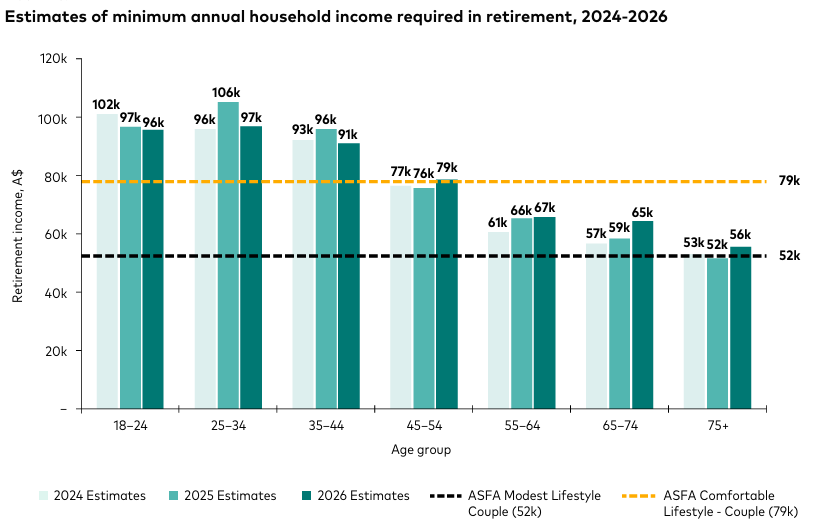
Obviously, there's an inflation caveat here. Someone retiring decades from now shouldn't be expected to nominate the same dollar figure as someone retiring today.
But I still find the gap fascinating.
Younger Australians aren't merely contemplating a retirement with potentially higher housing costs. They're also envisioning a retirement requiring substantially more nominal income.
Travel, hobbies and maintaining their health all feature prominently in what Australians say they want from retirement; the challenge is funding it!
If you're going into retirement still paying for housing while simultaneously expecting a relatively high standard of living, something has to give: save more, work longer, spend less - or some combination of the three.
Which brings us neatly to chart four.
4. Australians expect to work longer than today's retirees
I don't mean to sound morbid, but "working to the grave" - or at least closer to it - is a bit of a theme emerging from Vanguard's latest report.
Most working-age Australians expect to retire at around 66 or 67, several years later than today's retirees, who reported retiring at an average age of around 63.
But even reaching retirement age may not mean putting your feet up and saying goodbye to work altogether. Just 34% of working-age Australians expect to finish work completely, compared with 56% of today's retirees.
Instead:
- 18% expect to work part-time somewhere else
- 14% expect to continue in the same job on reduced hours
- 8% plan to start a business
- 1% envisage starting an entirely new career
- 25% haven't decided what they'll do yet.

Now, working later in life isn't necessarily a bad thing. Some people genuinely love what they do, enjoy the social interaction or would prefer to gradually wind down rather than go from full-time work to nothing overnight.
But put this chart alongside the housing findings and a more uncomfortable possibility emerges: some Australians may remain locked into the workforce for longer not because they want to, but because they have to.
5. Australians are most confident in the investment that does the least heavy lifting
Livewire readers, if you ever wanted more evidence that you perhaps live in a financial bubble - and possess far more investment knowledge than the average Australian - this report is proof in the pudding.
The humble savings account is the financial product Australians understand best, with 56% saying they were very or extremely confident in their understanding.
But venture into the products that regularly fill the pages of Livewire and confidence falls off a cliff.
Only around one-third of Australians reported high confidence in understanding superannuation, while confidence was even lower for equities, managed funds, ETFs, bonds and annuities.

For those of us who spend our days debating whether an ETF charges 20 or 30 basis points, whether the S&P 500 is too concentrated or whether Australian equities are cheap, those numbers are quite the reality check.
And knowledge of super itself isn't exactly stellar:
- Just 38% of Australians correctly identified when they can access their super, down from 40% last year.
- Nearly one in two Australians wouldn't feel confident explaining the fees charged on their super account to a friend or family member.
- More than one-third were either not very aware or not at all aware that super funds may charge multiple fees.
6. Five actions could triple retirement confidence
Let's finish with something more uplifting: Vanguard created a hypothetical 38-year-old called Alex.
Alex earns $90,000, owns a home with a mortgage, has $70,000 in super and $35,000 in personal investments.
But Alex isn't particularly engaged with retirement. They don't have a plan, have gaps in their financial literacy, don't fully understand super and the Age Pension, have never made voluntary super contributions and rarely check their super.
Vanguard then modelled what happens if Alex changes those five things.

Alex's probability of having high retirement confidence triples from 21% to 64%. Meanwhile, the probability of having low confidence collapses from 25% to just 2%.
I love this chart because Alex doesn't suddenly win Powerball. Their salary doesn't double. Their mortgage doesn't disappear. Nobody hands them a $500,000 inheritance.
They simply become more engaged with their retirement - and the difference is enormous.
And that's what makes this perhaps the most important chart in the report for you, your kids or anyone who needs a little motivation to take their retirement more seriously.
As Vanguard's Managing Director, Asia Pacific, Daniel Shrimski, puts it:
“Our findings suggest small actions today can make a big difference tomorrow. Developing a retirement plan was the factor most strongly associated with confidence, highlighting the importance of planning ahead.”
What it all means
Vanguard's report paints a confronting picture: younger Australians face bigger housing debts, later retirements and potentially more years in the workforce, while significant gaps remain in our understanding of super and investing.
But their example of Alex offers some good news. You don't need to transform your finances overnight to improve your retirement confidence.
Make a plan. Learn more about investing. Understand your super. And, where appropriate, consider seeking financial advice.
The retirement dream may be changing, but the earlier you engage with your future, the better your chances of hanging up your boots when you actually want to.
We've published plenty of useful resources on Livewire covering everything from the top-performing super funds to tax planning strategies. Check them out in our Retirement section.

Education
The top-performing growth super funds of the past decade (and the strategy they share)
View

Asset Allocation
Adam Dawes’ masterclass on investing for a wealthy retirement
View

Education
3 changes that helped my super grow faster
View
Never miss an update
Enjoy this wire? Hit the ‘like’ button to let us know.
Stay up to date with my current content by
following me below and you’ll be notified every time I post a wire
I have over 15 years’ experience covering financial markets and property, with a particular interest in ETFs and personal finance. I split my time between Australia and Canada to bring a global perspective to my work.
........
Livewire gives readers access to information and educational content provided by financial services professionals and companies ("Livewire Contributors"). Livewire does not operate under an Australian financial services licence and relies on the exemption available under section 911A(2)(eb) of the Corporations Act 2001 (Cth) in respect of any advice given. Any advice on this site is general in nature and does not take into consideration your objectives, financial situation or needs. Before making a decision please consider these and any relevant Product Disclosure Statement. Livewire has commercial relationships with some Livewire Contributors.

3 topics

I have over 15 years’ experience covering financial markets and property, with a particular interest in ETFs and personal finance. I split my time between Australia and Canada to bring a global perspective to my work.
Expertise
I have over 15 years’ experience covering financial markets and property, with a particular interest in ETFs and personal finance. I split my time between Australia and Canada to bring a global perspective to my work.
Expertise
Comments
Comments
Sign In or Join Free to comment