TOL - 9th Jul, 2026
When it comes to income, home is where the yield is
Why Yarra's Darren Langer believes Australian bonds offer a rare combination of attractive income, portfolio defence & compelling value.
 Add us as a preferred Google source
For much of the past two decades, fixed income investors have largely been forced to make a trade-off. Chase higher income through credit, or prioritise the defensive qualities of government bonds. Rarely have both opportunities existed at the same time.
That may finally be changing. Higher interest rates have reset bond markets, Australia has emerged as one of the healthier developed economies from a fiscal perspective, and investors are once again being paid attractive yields without sacrificing the defensive qualities that fixed income can provide when equity markets come under pressure.
According to Darren Langer, Co-Head of Australian Fixed Income at Yarra Capital Management, the current backdrop is unlike anything he has seen for years.
"This is probably the first time in a long time we've seen such a well-balanced market," says Langer.
"We're in that really sort of Goldilocks zone where it doesn't really matter as much about what kind of flavour fixed income you have at the moment."
The opportunity hasn't gone unnoticed. Yarra's Australian Bond Fund was recently recognised as Australian Bond Fund Manager of the Year at the 2026 Money Management Lonsec Fund Manager of the Year Awards, reflecting a strategy that has consistently navigated changing market conditions.
In this interview, Langer explains why Australia stands out from many overseas markets, why investors should think beyond simply owning credit, why combining fixed and floating rate strategies can produce a smoother ride over time, and how he's positioning the portfolio for the next phase of the interest rate cycle.
A rare opportunity for bond investors
The current environment isn't just attractive because yields are higher. Langer says it's because investors are finally being rewarded across multiple parts of the fixed income market at the same time.
"You don't often get that balance," he says.
"Quite often you get markets either skewed one way towards credit or another way towards rates, depending on the state of the economy."
Higher starting yields mean investors no longer have to rely solely on capital gains to generate returns. Instead; income, duration and selective credit exposure can all contribute to portfolio performance.
For Langer, that's where an active approach becomes important. Rather than relying on a single source of returns, the strategy rotates between different parts of the fixed income market as opportunities emerge.
"We're trying to capture a fixed income return that's consistent across the entire cycle," he says.
Instead of chasing credit spreads alone, the fund actively shifts between government bonds, semi-government securities and credit as valuations change, aiming to deliver consistent returns while keeping portfolio volatility under control.
Why Australia stands out

While much of the investment conversation centres on the United States, Langer believes Australia currently offers one of the more compelling fixed income opportunities globally.
Many developed economies are grappling with sluggish growth, elevated government debt and persistent budget deficits. Australia isn't immune to fiscal challenges, but compared with many developed market peers, its starting point remains considerably stronger.
"We don't have much government debt," Langer observes, comparatively speaking.
"We have positive demographics in Australia. There are a lot of things going for continuing to be able to pay our bills."
That stronger fiscal backdrop is reflected in Australia's bond market. Credit spreads remain attractive, interest rates are comparatively high and political stability provides an additional layer of confidence for investors.
For Australian investors, Langer believes that's a compelling argument for maintaining a home bias rather than taking additional offshore risk.
"The dynamics of the economy favour Australia and the shape of the yield curve here is also attractive," he says.
"There are lots of dynamics in the Australian market that you can get without taking that additional volatility risk of having to go offshore."
Fixed income is more than just credit

One of Langer's strongest messages is that investors often think too narrowly about fixed income.
While credit plays an important role, he believes focusing exclusively on credit means overlooking opportunities elsewhere in the market.
Instead, Yarra actively allocates across government bonds, semi-government securities, supranationals, investment-grade credit and residential mortgage-backed securities (RMBS), depending on where relative value exists.
A key principle is avoiding long-dated credit, where investors take significantly more risk without receiving sufficient additional compensation.
"If you're going to buy long-dated credit today, you're not actually getting paid for the risk," Langer says.
Instead, the fund favours shorter-dated credit for income while using government and semi-government bonds further along the curve to express views on interest rates and relative value.
That flexibility allows the portfolio to rotate between sectors as valuations change rather than remaining anchored to a single part of the market.
"What we're trying to do is take the parts of the credit market we think are most attractive."
Why owning both fixed and floating makes sense
.png)
Another common misconception, according to Langer, is that investors should choose between fixed-rate and floating-rate strategies.
His preference is to own both.
While floating-rate strategies generally perform better when credit markets are strong, fixed-rate portfolios tend to provide greater protection when growth slows and interest rates begin falling.
When combined, the two approaches can produce smoother returns than either strategy in isolation.
Table showing returns of the Yarra Enhanced Income Fund, Yarra Australian Bond Fund (before fees), and the combined returns, versus various benchmarks
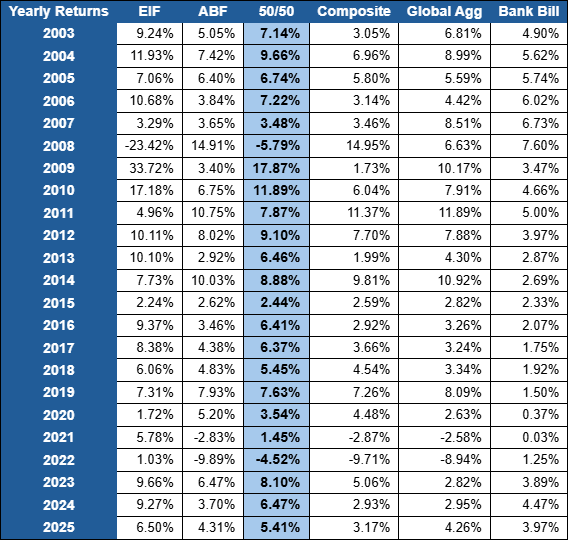
"You actually get a better outcome than any of the indexes or any individual products you might hold, but you also get lower volatility," Langer says.
That same principle applies to portfolio construction more broadly. Unlike cash or term deposits, fixed income has the potential to provide both income and diversification when equity markets come under pressure.
"Cash and term deposits don't provide you any offset when equities go haywire and they don't give you quite as much income as what fixed income will over that longer period of time."
For investors with longer investment horizons, Langer believes fixed income should be viewed as a strategic allocation rather than simply somewhere to park excess cash.
Positioned for what's next
Today's portfolio positioning reflects Yarra's expectation that Australian economic growth will remain subdued and that the Reserve Bank of Australia may need to lower interest rates sooner than markets currently expect.
That has led the fund to maintain an overweight duration position while favouring sectors that offer attractive spreads without taking excessive credit risk.
Residential mortgage-backed securities remain a particularly attractive source of income, providing AAA-rated exposure with relatively low volatility, while semi-government bonds continue to offer compelling value further along the yield curve.
Importantly, Langer says the team remains focused on preserving flexibility rather than making outsized macro bets.
"The really dangerous thing, I guess, is if suddenly we got a pick-up in growth that we're not expecting."
Longer term, he believes sticky inflation, ageing populations and deteriorating government finances across many developed economies will become increasingly important themes for bond investors.
For now, however, he believes investors are being presented with a combination that has been difficult to find for much of the past two decades: attractive income, defensive characteristics and the flexibility to adapt as market conditions evolve.
Given that backdrop, it's little surprise Langer describes today's environment as a "Goldilocks zone" for fixed income investors.
Never miss an update
Enjoy this wire? Hit the ‘like’ button to let us know.
Stay up to date with my current content by
following me below and you’ll be notified every time I post a wire
My passion is equity research, portfolio construction, and investment education. There are some powerful processes that can help all investors identify great opportunities and outperform the market, and I want to bring them to life and share them with you.
........
Livewire gives readers access to information and educational content provided by financial services professionals and companies ("Livewire Contributors"). Livewire does not operate under an Australian financial services licence and relies on the exemption available under section 911A(2)(eb) of the Corporations Act 2001 (Cth) in respect of any advice given. Any advice on this site is general in nature and does not take into consideration your objectives, financial situation or needs. Before making a decision, please consider these and any relevant Product Disclosure Statement. Livewire has commercial relationships with some Livewire Contributors.

5 topics
1 contributor mentioned

My passion is equity research, portfolio construction, and investment education. There are some powerful processes that can help all investors identify great opportunities and outperform the market, and I want to bring them to life and share them...
Expertise
My passion is equity research, portfolio construction, and investment education. There are some powerful processes that can help all investors identify great opportunities and outperform the market, and I want to bring them to life and share them...
Expertise
Comments
Comments
Sign In or Join Free to comment