TOL - 30th Jun, 2026
Which ASX stocks would Buffett buy?
I built a stock screen based on Warren Buffett’s investing philosophy. Thirty-five companies survived. Only three made the final cut.
 Add us as a preferred Google source
Like Wile E. Coyote chasing the Roadrunner, Livewire has been chasing Warren Buffett for years. The closest we ever came? A courteous, handwritten letter from his secretary politely declining an invitation to speak at Livewire Live. Now 95 years old, our chance of getting him sits firmly between slim and none.
Trying to cram Buffett's investment style into a box is an equally elusive and perilous task. For starters, how can one possibly hope to reduce a dynamic, evolving investment style to a handful of factors?
Some of you might argue that his style is not worth analysing. Some will think that it can't possibly be done. Some will ask, 'Why bother?' And some of you will accept the exercise for what it is - a fun thought experiment, not to be taken as advice.
Yet here you all are, enticed by the headline and the lure of what might follow.
The OG's philosophy
Buffett doesn’t buy companies because they’re household names or because they’re universally regarded as “quality”.
He first looks for businesses with exceptional financial characteristics. Those companies then become candidates for much deeper research into their competitive advantages, management quality and long-term prospects.
That got me thinking. If Buffett landed in Australia tomorrow with nothing but a Bloomberg terminal, where would he start?
So I built the closest thing I could to a Buffett stock screen. The result wasn’t a list of “Buffett stocks”. It was a list of companies that deserved a closer look.
Buffett isn’t looking for cheap stocks
One of the biggest misconceptions about Buffett is that he's simply a value investor chasing low price-to-earnings ratios. That hasn't been true for decades.
As the late Charlie Munger persuaded him long ago, it's better to buy a wonderful business at a fair price than a fair business at a wonderful price.
That shift transformed Berkshire Hathaway and explains why companies like Coca-Cola, American Express, Moody's and Apple became core holdings.
So, can you identify businesses with those characteristics using a stock screen? Not perfectly. But you can get surprisingly close.
Building a Buffett screen
Buffett has never claimed a spreadsheet can identify a great business. A screen can't measure an economic moat, assess management quality or judge whether customers genuinely love a product. Those insights come from deep research.
What a screen can do is narrow the field. So rather than trying to screen for Buffett's ideal company, I screened for the financial characteristics he has consistently prized throughout Berkshire Hathaway's shareholder letters. The result was a shortlist of businesses worthy of further investigation.
- #1 - Cash Flow Return on Invested Capital >10%: Buffett wants businesses that turn investment into cash efficiently. Strong cash returns are often a hallmark of durable businesses.
- #2 - Return on Invested Capital >15%: One of the best indicators of a business with pricing power and a competitive advantage.
- #3 - ROE 1 yr Fwd >20%: Measures a company’s ability to generate attractive returns for shareholders.
- #4 - EPSg 5 yr Hist >10%: Buffett values consistency. Businesses that have grown earnings over long periods are often doing something right.
- #5 - PE 1 yr Fwd <25: Buffett isn’t afraid to pay for quality, but he still insists on a sensible price.
- #6 - Net Debt to Equity 1 yr Fwd <50: Great businesses shouldn’t rely on excessive leverage to generate attractive returns.
Each factor does some heavy lifting. None of them, however, can identify the one thing Buffett values most - a moat. That’s where the numbers stop, and judgment begins.
Thirty-five companies made it through the first gate
Applying those six filters to the ASX produced 35 companies, which initially looked promising. Many of them displayed exactly the traits the screen was designed to capture: strong returns on capital, solid cash generation and reasonable valuations.
Upon closer inspection, however, many were very clearly not Buffett-style businesses - Exhibit A: Qantas. Buffett is not fond of airlines
He has spent most of his career avoiding businesses that lack durable competitive advantages or rely on favourable conditions to perform well. His eventual exit from airlines in 2020 reinforced that view.
This highlighted a key limitation of any screen. It can point you toward financially attractive businesses, but it can’t tell you whether those returns are sustainable. That’s where judgment comes in, and where the second stage of the process begins.
The shortlist
After removing businesses that Buffett would likely dismiss because of their industry structure, cyclicality or lack of a durable competitive advantage, the list became much shorter.

- Cochlear (COH): Perhaps Australia's clearest example of an economic moat.
- Computershare (CPU): Sticky customers, recurring revenue and infrastructure-like economics.
- GQG Partners (GQG): Founder-led, highly cash generative and asset light, albeit in a more competitive industry.
- JB Hi-Fi (JBH): Outstanding execution and capital allocation, though retail isn't Buffett's usual hunting ground.
- Medibank (MPL): Predictable cash flows and insurance economics, offset by regulatory risk.
- QBE Insurance (QBE): Buffett loves insurance, but catastrophe exposure adds volatility.
- ResMed (RMD): Global healthcare leadership, recurring demand and exceptional returns on capital.
The three businesses Buffett would probably spend his time on.
The purpose of this exercise wasn’t to identify the highest-quality companies on the ASX. It was to identify the businesses most closely aligned with Buffett’s documented investment philosophy. Three stand above the rest.
#1 - Computershare (ASX: CPU)
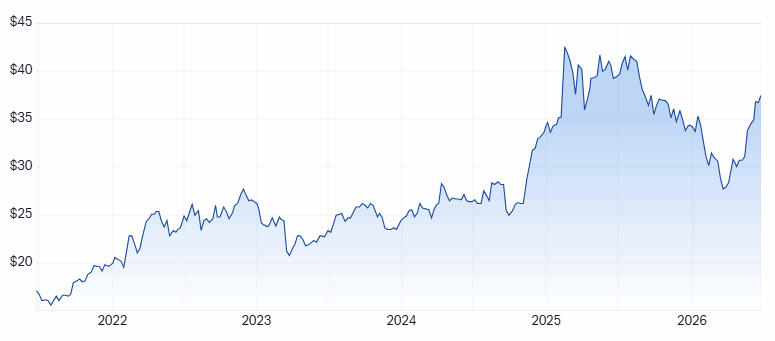
If Buffett likes boring businesses with exceptional economics, Computershare fits the bill.
It occupies an essential role in global capital markets, providing share registry, employee equity plan administration and corporate trust services across multiple jurisdictions. Once appointed, customers rarely switch providers because the cost and complexity far outweigh any potential savings.
That creates sticky relationships, recurring revenue and consistently attractive returns on capital. It’s exactly the sort of business that quietly compounds value year after year.
On a May episode of Buy Hold Sell, Plato's Peter Gardner rated CPU a BUY and said the following:
"The thing about the Computershare business is that they do investor services, but they're also very exposed to what interest rates are going to do. So when interest rates are going up, they get a benefit. When interest rates fall, they take a hit.
We think in Australia, at least, interest rates look like they're going up over the next year, so it's a buy for us".
The reader poll attached to that episode saw 23% of 569 voters rate CPU a BUY, whilst 51% said HOLD, and 26% said SELL.
#2 - Cochlear (ASX: COH)
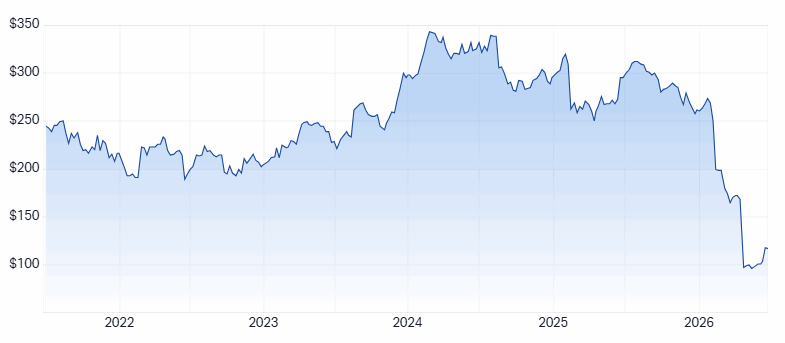
If there is an Australian company that best embodies the concept of an economic moat, Cochlear is probably it.
Its leadership in implantable hearing technology has been built over decades of research, intellectual property and surgeon relationships. New competitors face enormous barriers to entry, while existing patients often remain within the Cochlear ecosystem for life.
The only thing Buffett might dislike is the valuation, although that has become more appealing given the recent downgrade and share price fall. Great businesses rarely come cheaply.
On a recent episode of Buy Hold Sell, Ten Cap's Jun Bei Liu highlighted COH as a stock she's watching. She acknowledged there could be another downgrade, with management looking to be conservative given recent misses, but ultimately she remains positive on the longer-term story.
"We just need the market to return to a more normal environment, and for analysts to bring their expectations back down to earth. I think it's getting very, very close, and this is a once-in-a-five-to-10-year opportunity to get it cheap like this".
#3 - ResMed (ASX: RMD)
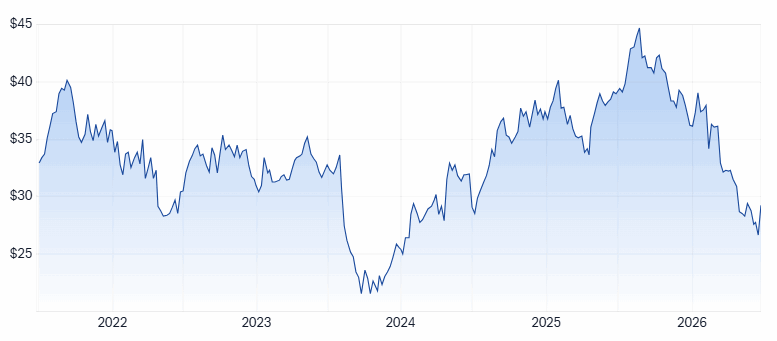
ResMed combines everything Buffett looks for in a business. It operates in a growing market, holds a leadership position, generates attractive returns on capital and benefits from recurring demand as patients replace masks and accessories over time.
Unlike many healthcare companies, its economics don’t rely solely on discovering the next blockbuster product. Its competitive position has been built over decades through technology, clinical relationships and global distribution. Those are difficult advantages to replicate.
On a recent Buy Hold Sell episode, ClearBridge's Reece Birtles nominated RMD as a stock that could have a big 12 months ahead.
"Revenue growth is still running at high single digits and earnings per share growth is around 10%. Having looked at this stock over the last 20 years, there have probably only been three really good valuation opportunities to buy it. At 16 times earnings for double-digit growth, we think it's been mispriced in the current market and should do well ahead".
As good as it gets
Building a Buffett screen turned out to be the easy part. Using six factors grounded in his investing philosophy reduced the ASX to just 35 companies.
The hard part was everything that came next. Buffett's edge was never his spreadsheet, it was recognising which businesses were worth understanding after the spreadsheet had done its job.
Financial metrics can point you towards exceptional companies, but they can't measure pricing power, intelligent capital allocation or the strength of an economic moat. That, perhaps more than anything else, is the lesson from this exercise.
When it comes to the Oracle of Omaha, save for a handwritten letter from his secretary, that's about as close as we're likely to get.
Never miss an update
Enjoy this wire? Hit the ‘like’ button to let us know.
Stay up to date with my current content by
following me below and you’ll be notified every time I post a wire
My passion is equity research, portfolio construction, and investment education. There are some powerful processes that can help all investors identify great opportunities and outperform the market, and I want to bring them to life and share them with you.
........
Livewire gives readers access to information and educational content provided by financial services professionals and companies ("Livewire Contributors"). Livewire does not operate under an Australian financial services licence and relies on the exemption available under section 911A(2)(eb) of the Corporations Act 2001 (Cth) in respect of any advice given. Any advice on this site is general in nature and does not take into consideration your objectives, financial situation or needs. Before making a decision, please consider these and any relevant Product Disclosure Statement. Livewire has commercial relationships with some Livewire Contributors.

4 topics
3 stocks mentioned

My passion is equity research, portfolio construction, and investment education. There are some powerful processes that can help all investors identify great opportunities and outperform the market, and I want to bring them to life and share them...
Expertise
My passion is equity research, portfolio construction, and investment education. There are some powerful processes that can help all investors identify great opportunities and outperform the market, and I want to bring them to life and share them...
Expertise
Comments
Comments
Sign In or Join Free to comment