Why not all bank hybrid replacements are equal
Not all hybrid replacements are created equal. Here's why chasing the highest yield could cost you more than you think.
 Add us as a preferred Google source

Pranay Lal
With Australian big bank hybrids being phased out, many investors are now looking for alternative sources of income. The challenge is that not all replacement options carry the same risks. While investments such as Tier 2 bank debt, corporate hybrids and global subordinated debt are often grouped together, they can differ meaningfully in credit quality, complexity and downside risk.
For years, ASX-listed hybrids were a familiar source of income for Australian investors. They offered exposure to major banks and paid floating-rate income while typically providing higher yields than senior credit. But with APRA phasing hybrids out of banks’ regulatory capital requirements, investors are now seeking alternatives that can preserve income without moving unnecessarily down the risk spectrum.
Tier 2 subordinated debt is the natural starting point for that comparison. These are bonds issued by banks and insurers to help meet their regulatory capital requirements. As the below figure shows, they sit higher than hybrids in the capital structure, meaning investors have a stronger claim if an issuer gets into financial trouble. For investors who previously relied on hybrids for income, Tier 2 can provide a way to maintain exposure to Australia's banking sector while moving into a higher-quality part of the capital structure.
Figure 1: Bank Hybrids versus Tier 2 capital structure comparison

Subordinated debt label can be misleading
Investors seeking to replace hybrid income may also consider corporate hybrids. While Tier 2 subordinated debt and corporate hybrids are often grouped together, they are not interchangeable. Each carries a different mix of issuer, structural, regulatory and credit risks that should be carefully assessed before investing.
Unlike Tier 2 securities, corporate hybrids are issued by non-financial companies such as REITs and utilities. They also tend to have more complex terms, including the ability for issuers to defer income payments or convert the security into equity under certain conditions. Those differences can have a meaningful impact on risk and returns.
Subordinated debt is not one credit profile
While it is natural for investors to begin with headline yield when comparing subordinated debt, this figure alone does not tell the full story. Additional yield is compensation for additional risk. This risk can include lower credit quality, greater structural complexity, offshore exposure and weaker liquidity. Higher yield may be appropriate in some portfolios, but it should not be treated as a free source of return.
Australian financial Tier 2 securities benefit from stronger domestic banking system assessments and, in some cases, government support assumptions. Global subordinated debt, in contrast, often misses this uplift and carries offshore resolution risk. Corporate subordinated debt is different again, with credit outcomes more directly tied to the financial strength of issuers that are typically less regulated and more exposed to cyclical earnings risk. For investors replacing hybrid income, the focus should be on balancing income with risk, rather than chasing yield alone.

Yield needs to be earned
Chasing a higher yield is easy, but the harder question is whether the additional return is sufficient compensation for the extra risk.
At face value, corporate subordinated debt offers the most obvious yield uplift, although at a much smaller market capitalisation. Global subordinated debt provides a larger opportunity set, but the average yield is not materially different from locally issued Tier 2 debt.
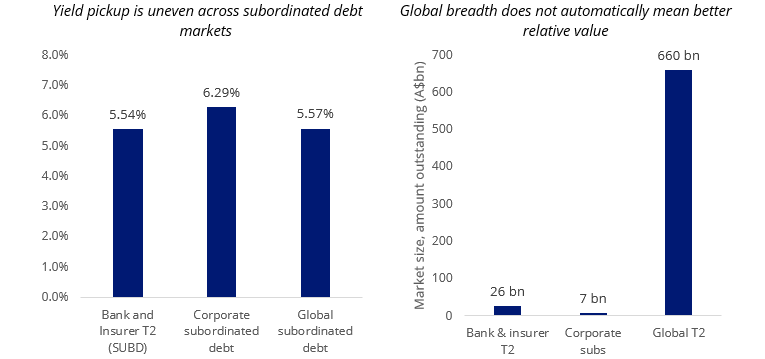
From a portfolio construction perspective, the objective should be to preserve income while improving the quality and resilience of the exposure, and not to just move these assets into the highest yielding portfolio available.
Corporate subordinated debt may offer higher yields, but that typically means taking on exposure to more cyclical companies. Global subordinated debt broadens the investment universe, but it also brings additional complexity through different regulatory regimes, capital structures and currency exposure. Put simply, more choice doesn't automatically mean better value if the extra yield comes with higher risk.
For investors who are adamant on achieving a higher yield, this could be achieved by moving down the credit spectrum. However, doing this materially alters the portfolio risk profile. The next chart showing the historical drawdown behaviour of various subordinated debt instruments helps illustrate the trade-off.
Figure 2: Drawdowns reveal the cost of lower-quality exposure

Performance needs the right benchmark
Before comparing returns, investors should ask whether these portfolios actually take the same level of risk.
A floating-rate subordinated debt portfolio should generally outperform cash, so using cash as a benchmark can make fairly ordinary returns look like something more impressive.
The same goes for comparing different types of funds. A portfolio focused on Australian Tier 2 isn’t comparable with a broader income strategy that invests across global issuers or lower-quality credit. If a fund is taking on more risk to generate extra yield, some outperformance should be expected. The key question is whether that extra return is enough to compensate for the added risk, complexity and potential downside.
Scale and track record matter
The VanEck Australian Subordinated Debt ETF (SUBD) was the first subordinated debt ETF launched in Australia to provide exposure to only AUD floating rate Tier 2 and remains the largest subordinated debt ETF with AUM of $3.7bn. Last year, we launched VanEck Australian Fixed Rate Subordinated Debt ETF (FSUB) providing exposure to AUD fixed rate Tier 2.
Crucially, SUBD has also been tested across different market environments including COVID, the sharp rise in interest rates in 2022 and periods of credit spread volatility. This track record, combined with its scale and established market role, supports efficient access to AUD Tier 2.
In addition, scale matters in primary Tier 2 issuance. New deals can price at more attractive levels than bonds already trading in the secondary market, so being a consistent, meaningful participant in primary issuance can help investors access better entry points. Regular engagement with issuer treasury teams can also support access to new deals and new tenor points, helping broaden the AUD Tier 2 opportunity over time.
The hybrid phase-out should be supportive for Tier 2, but investors still need to be selective. For investors replacing hybrid income, the objective should be risk-adjusted income, not yield at any cost.
Never miss an update
Enjoy this wire? Hit the ‘like’ button to let us know.
Stay up to date with my current content by
following me below and you’ll be notified every time I post a wire
By
Pranay Lal,
........
Any views expressed are opinions of the author at the time of writing and is not a recommendation to act.
VanEck Investments Limited (ACN 146 596 116 AFSL 416755) (VanEck) is the issuer and responsible entity of all VanEck exchange traded funds (Funds) trading on the ASX. This information is general in nature and not personal advice, it does not take into account any person’s financial objectives, situation or needs. You should consider whether or not an investment in any Fund is appropriate for you. Investments in a Fund involve risks associated with financial markets. These risks vary depending on a Fund’s investment objective. Refer to the applicable product disclosure statement (PDS) and target market determination (TMD) available at vaneck.com.au for more details. Investment returns and capital are not guaranteed.
An investment in our Australian Subordinated Debt ETF carries risks associated with: subordinated debt, bond markets generally, interest rate movements, issuer default, credit ratings, fund operations, liquidity and tracking an index. See the VanEck Australian Subordinated Debt ETF PDS and TMD for more details.
SUBD is likely to be appropriate for a consumer who is seeking capital preservation and a regular income distribution, is intending to use the product as a minor or satellite allocation within a portfolio, has an investment timeframe of at least 3 years, and has a medium risk/return profile.
FSUB is likely to be appropriate for a consumer who is seeking a regular income distribution, is intending to use the product as a minor or satellite allocation within a portfolio, has an investment timeframe of at least 3 years, and has a medium risk/return profile.
5 topics
1 stock mentioned
Pranay Lal
Expertise
Pranay Lal
Expertise
Comments
Comments
Sign In or Join Free to comment